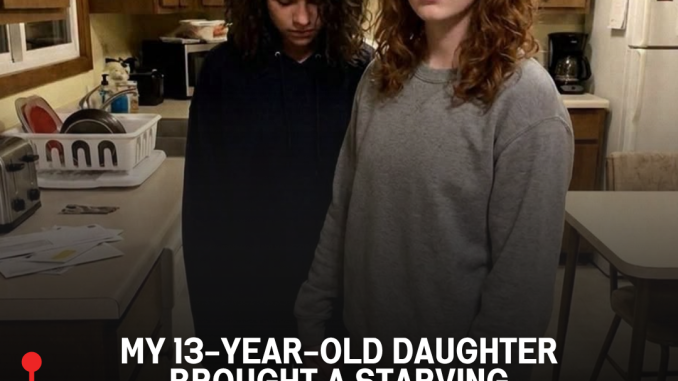
In our household, the word “enough” had never been as simple as it sounded. Every month, we carefully balanced grocery costs, utility bills, and the everyday expenses that seemed to keep piling up. We weren’t struggling to survive, but we were always conscious of how quickly one unexpected expense could throw everything off.
I had become good at stretching meals, planning ahead, and making every dollar count. I believed that if we worked hard and stayed disciplined, we could keep our family steady.
Then, one Tuesday afternoon, my thirteen-year-old daughter came home with a classmate—and unknowingly brought a much bigger problem through our front door.
The Quiet Girl Who Seemed Exhausted
My daughter, Sam, walked into the house beside a girl I had seen around school but never really met.
Her name was Lizie.
She was thin, quiet, and looked exhausted beyond her years. Her oversized hoodie seemed to swallow her small frame, and she barely looked up when I greeted her.
Before I could ask what was going on, Sam simply said, “Lizie is having dinner with us.”
I looked toward the meal I had prepared and hesitated for a moment. We were already careful with our food budget, but I couldn’t bring myself to turn her away.
So I set another place at the table.
What happened next stayed with me.
Lizie ate slowly and cautiously. She took tiny portions and seemed almost afraid to take more. She kept glancing at the food as if she needed to make sure there would be enough for everyone else.
It wasn’t the normal eating behavior I expected from a teenager.
It looked like someone who had learned not to assume there would be another meal.
When One Visit Became a Pattern
After that evening, Lizie started coming over more frequently.
She was always polite. Almost too polite.
She apologized for everything—taking a glass of water, sitting on the couch, accepting another serving of food. She behaved as though simply being in our home was an inconvenience.
Sam noticed it too.
One day, she told me that Lizie had fainted at school. She also said Lizie often skipped lunch and sometimes claimed she wasn’t hungry when everyone knew she was.
I wanted to help, but I also felt conflicted.
Our own finances were tight. We couldn’t simply solve someone else’s problems when we were already working hard to manage our own.
Still, something about Lizie made it impossible to ignore.
There had to be more to the story.
Then Her Backpack Fell Open
A few days later, Lizie came over after school.
When she dropped her backpack near the kitchen table, the zipper suddenly gave way, and its contents spilled across the floor.
I immediately bent down to help her gather everything.
Then I saw the papers.
There were overdue bills, utility notices, and handwritten calculations covering several pages. Some of the notes listed expenses and amounts of money, as though someone had been desperately trying to figure out how to make a nearly impossible budget work.
Then I noticed a small notebook.
One page was titled:
“What we take first if we have to leave our home.”
I froze.
I gently asked Lizie what it meant.
For several seconds, she said nothing.
Then she finally began to cry.
The Truth She Had Been Hiding
Lizie told me that she and her father had been struggling for months.
Her mother had died, leaving her father to raise her alone. He had been doing everything he could to keep their household together, but the bills had become overwhelming.
They were behind on payments and worried about losing their home.
Lizie had been skipping meals because she didn’t want to make things harder for her father.
She had also been afraid to tell anyone.
She wasn’t simply hungry.
She was terrified that everything familiar in her life was about to disappear.
Suddenly, all those little things I had noticed made sense—the tiny portions, the apologies, the fear of taking too much.
She wasn’t being shy.
She was trying to survive.
Her Father Was Struggling Too
When Lizie’s father came to pick her up later that day, I expected anger or embarrassment.
Instead, I saw exhaustion.
He looked like a man who hadn’t had a chance to breathe in months.
At first, he apologized repeatedly. He said he hadn’t wanted anyone to know how bad things had become. He was embarrassed and afraid people would judge him as a father.
But it quickly became clear that he wasn’t neglecting his daughter because he didn’t care.
He was overwhelmed.
He had been trying to carry an impossible burden by himself.
And Lizie had been carrying part of it right alongside him.
That conversation changed everything.
Instead of hiding their situation, we decided to start looking for help.
Sometimes Asking for Help Changes Everything
I contacted the school and asked what support might be available.
There were meal programs, counselors, and community resources we hadn’t even known existed. People began connecting Lizie’s family with assistance programs and housing resources.
None of it solved everything overnight.
But little by little, things began improving.
Lizie started receiving regular meals at school. Her father gained access to resources that helped him catch up on some of the bills. Their housing situation became more stable.
Most importantly, they no longer had to pretend everything was fine.
The secret that had been crushing them was finally out in the open.
Watching Lizie Become Herself Again
Over the following months, I watched Lizie change.
She laughed more.
She talked more.
She stopped apologizing every time someone offered her something.
And most noticeably, she stopped eating as though every bite might be her last.
Sam changed too.
She became more aware of how easily people can hide struggles behind ordinary clothes, polite smiles, and the words, “I’m fine.”
My daughter had invited a classmate home for dinner.
Instead, she had unknowingly opened the door to a family that desperately needed someone to notice.
What “Enough” Really Means
Our own financial situation didn’t suddenly change.
We still watched our spending. We still planned meals and thought carefully before making purchases.
But our understanding of what it means to have “enough” changed completely.
Now, when Lizie comes over for dinner, I don’t worry about whether we have enough food for one more person.
I simply put another plate on the table.
Because having enough isn’t always about how much is in your refrigerator or how much money is in your bank account.
Sometimes, having enough means being willing to share what you have.
The Lesson We Will Never Forget
Lizie didn’t need someone to rescue her.
She needed someone to notice.
She needed a safe place where she could finally admit that she was scared.
She needed adults who were willing to listen without judging her or her father.
And our family learned something just as important.
Struggles become easier to carry when they aren’t carried alone.
That little girl came to our house because she was hungry.
But what she ultimately found was something bigger than a meal.
She found a place where she felt safe.
And in opening our home to her, we discovered something we had never fully understood before:
“Enough” isn’t simply a number. Sometimes, enough is what happens when people choose to care for one another—even when life isn’t easy.
Sometimes, all it takes is one extra plate at the table to remind someone that they don’t have to face the hardest moments alone.