The laughter began before Aaron even reached the principal.
I sat frozen in the third row, my hands clasped so tightly that my knuckles had turned white.
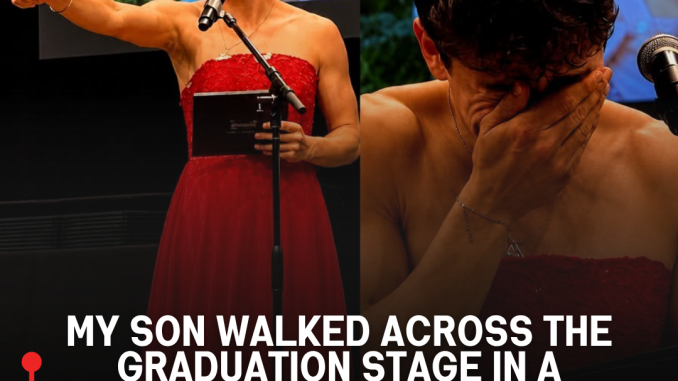
My eighteen-year-old son was walking across the graduation stage wearing a bright red dress.
Not a costume.
Not something he had put on as a joke.
It was Mary’s dress.
His twin sister’s dress.
For several seconds, I could hear nothing except the pounding of my heart.
Then someone behind me whispered, “What is he doing?”
Another student laughed.
A phone rose into the air.
Then another.
Aaron heard every word.
I could see it in the way his shoulders tightened slightly.
But he didn’t stop.
He kept walking.
His chin stayed lifted.
And in that moment, I understood.
My son wasn’t trying to shock anyone.
He was keeping a promise.
Months earlier, Mary had stood in front of her bedroom mirror wearing that same dress.
She twirled around and looked at Aaron.
“Too much?”
He laughed.
“You look ridiculous.”
She grabbed a pillow and threw it at him.
A moment later, they were both laughing.
It was one of the last completely ordinary afternoons we would ever have together.
Mary had been undergoing treatment for a serious illness, and without realizing it, we had started treating those ordinary moments as something precious.
That afternoon, she insisted on stopping at a small clothing store near the hospital.
She found the red dress almost immediately.
“It’s perfect,” she said.
Aaron shook his head.
“You’re going to make everyone stare at you.”
“That’s the point.”
She smiled.
On the way back to the hospital, they stopped outside because Mary wanted some fresh air.
She noticed a tiny yellow daisy growing beside the sidewalk.
Carefully, she picked it.
“Look,” she said.
Aaron told her she shouldn’t be picking flowers from the hospital grounds.
She rolled her eyes.
Then she tucked the little daisy inside a book she was carrying.
Neither of them knew that tiny flower would later become one of the most important things we had left of her.
Mary died before graduation.
She never got the chance to walk across that stage.
After she was gone, Aaron changed.
He stopped playing baseball.
He barely answered messages.
He spent hours sitting alone in Mary’s room.
Sometimes I would find him holding the red dress.
One evening, his father, David, saw him with it.
“It’s just a dress,” he said.
I looked at him.
“No,” I replied. “It’s Mary’s.”
But grief changes people differently.
David became angry.
Aaron became quiet.
And I learned something painful: sometimes a mother can stand beside her own child and still have no idea how much pain he is carrying.
Three weeks before graduation, Aaron came into my bedroom.
“Mom?”
I looked up.
He was holding the red dress.
“I want to wear this.”
My heart stopped.
“To graduation?”
He nodded.
“Why?”
He looked down at the dress.
“Because Mary wanted me to.”
I didn’t ask anything else.
But David did.
When he found out, he became furious.
“You are not walking across a graduation stage dressed like that.”
Aaron didn’t argue.
He simply said, “I’m doing it.”
David refused to attend the ceremony.
Then Aaron’s closest friend suddenly stopped answering his messages.
Even the school counselor suggested that he wear something “more traditional.”
Aaron refused.
The night before graduation, he came into my room carrying the red dress.
“Mom?”
“Yes?”
“Will you sit somewhere I can see you?”
I pulled him into my arms.
“I’ll be right there.”
And I was.
When Aaron reached the middle of the stage, the laughter had almost completely disappeared.
He received his diploma.
The principal shook his hand.
Then Aaron turned toward the audience.
He wasn’t looking at the cameras.
He wasn’t looking at the other students.
He was looking directly at me.
He walked down the steps.
Then he reached into the pocket of Mary’s red dress.
He pulled out a tiny tissue-wrapped bundle.
When he reached me, he placed it in my hands.
“Open it.”
My fingers trembled.
Inside was the little yellow daisy Mary had picked that afternoon.
Beside it was a folded piece of paper.
I recognized Mary’s handwriting immediately.
I couldn’t breathe.
Aaron whispered, “She gave it to me before she died.”
I unfolded the letter.
It was short.
Mary had written that she knew there was a chance she might not make it to graduation.
She asked Aaron to wear her dress if she couldn’t be there.
Then she wrote something that completely broke me.
She said she didn’t want Mom to look toward the stage one day and feel like one of her children was missing.
She wanted Aaron to make sure I understood that both of them had made it.
I covered my mouth.
The entire auditorium had gone silent.
Aaron looked at me.
“She wanted you to know she was here.”
Then something happened that none of us expected.
The principal stepped toward the microphone.
He looked at Aaron.
Then he looked at the audience.
“I think,” he said, “we owe Aaron an apology.”
No one laughed.
No one moved.
The principal explained that he had received Mary’s letter earlier that morning after Aaron asked him to read it.
Then he asked Aaron if he could share one sentence with the graduating class.
Aaron hesitated.
Then nodded.
The principal read Mary’s words aloud.
“If I can’t walk beside my brother, let him carry me with him.”
There wasn’t a sound in the room.
Then the first person stood.
It was Ben.
Aaron’s former best friend.
Ben walked toward us with tears in his eyes.
“I should have asked,” he said.
Aaron stared at him.
Ben wiped his face.
“I thought it was a joke. I didn’t know.”
Aaron’s voice was quiet.
“You didn’t ask.”
Ben nodded.
“I know.”
Then he hugged him.
One by one, other students began approaching Aaron.
Some apologized.
Some told him they were sorry about Mary.
Others didn’t say anything at all.
They didn’t have to.
They understood.
Only minutes earlier, the red dress had looked strange to them.
Now they saw what it truly represented.
A sister’s final wish.
A brother’s promise.
A mother’s reminder that love doesn’t disappear simply because someone is gone.
When we finally left the auditorium, Aaron held my hand.
His father was waiting outside.
For several seconds, neither of them spoke.
Then David looked at his son.
“I was wrong.”
Aaron said nothing.
David swallowed hard.
“I thought I was protecting you from embarrassment.”
Aaron looked down at Mary’s dress.
“You were protecting yourself.”
David’s eyes filled with tears.
“Yes,” he whispered.
Aaron finally stepped forward.
His father hugged him.
I stood nearby, quietly crying.
Mary wasn’t there.
She never received her diploma.
She never heard the applause.
She never got another chance to wear her red dress.
But as Aaron walked away from that auditorium, I realized something.
She had still made it to graduation.
She had been there in every step.
And when my son crossed that stage, he wasn’t simply wearing his sister’s dress.
He was carrying her love with him.
And that was something no one in that auditorium would ever forget.