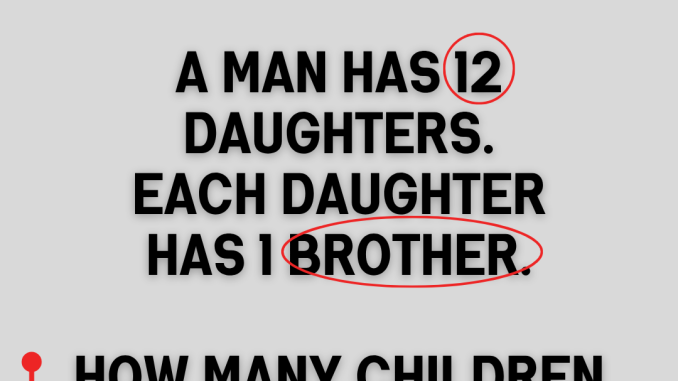
At first glance, this riddle seems like a simple counting problem. A man has 12 daughters, and every daughter has one brother. So how many children does the man have?
Many people immediately start adding numbers and assume the answer must be 24. But that is exactly where the trick lies.
The correct answer is 13 children.
The Riddle
Here is the puzzle:
A man has 12 daughters.
Each daughter has 1 brother.
How many children does the man have?
The key is to pay close attention to the wording.
The riddle does not say that every daughter has a different brother.
Instead, it says that each daughter has 1 brother.
That one brother can be the same person for all 12 daughters.
Breaking Down the Answer
Let’s imagine the family.
The man has:
- Daughter #1
- Daughter #2
- Daughter #3
- Daughter #4
- Daughter #5
- Daughter #6
- Daughter #7
- Daughter #8
- Daughter #9
- Daughter #10
- Daughter #11
- Daughter #12
That’s already 12 children.
Now we are told that each daughter has one brother.
There is no requirement for that brother to be different for each daughter. The 12 daughters can all have the same brother.
So we simply add one son to the 12 daughters:
12 daughters + 1 brother = 13 children.
Therefore, the man has 13 children in total.
Why Isn’t the Answer 24?
This is where the wording of the riddle catches people.
Someone might reason:
“There are 12 daughters, and each one has a brother. If each daughter has a brother, that’s 12 brothers.”
That would give:
12 daughters + 12 brothers = 24 children.
But that interpretation assumes that every daughter has a different brother.
The riddle never says that.
For example, imagine a family with 12 sisters and one boy. Every one of those 12 girls can truthfully say:
“I have one brother.”
The brother is the same boy in every case.
So the family contains:
12 girls + 1 boy = 13 children.
A Simple Real-Life Example
Imagine a father named Michael has 13 children.
Twelve of them are girls, and one is a boy named James.
The daughters are:
Emma, Olivia, Sophia, Ava, Mia, Isabella, Amelia, Charlotte, Harper, Evelyn, Abigail, and Ella.
James is their brother.
If you ask Emma:
“Do you have a brother?”
She can answer:
“Yes, James.”
Ask Olivia the same question:
“Do you have a brother?”
Again, the answer is:
“Yes, James.”
The same is true for all 12 daughters.
Every daughter has one brother, but there is still only one boy.
That’s the trick.
The Important Word: “Each”
The word “each” often makes this riddle confusing.
When we say:
“Each daughter has one brother,” we are describing the relationship between every daughter and her brother.
We are not saying:
“Each daughter has a different brother.”
That would be a completely different statement.
If the riddle said:
“A man has 12 daughters, and each daughter has a different brother,”
then the answer would be 24 children.
But because it simply says “each daughter has 1 brother,” the same brother can be shared by all 12 daughters.
The Mathematical Way to Look at It
The calculation is actually very simple:
12 daughters + 1 brother = 13 children
The mistake is treating the brother as a new child every time the riddle mentions him.
But the brother is one individual.
So we count him only once.
Final Answer
The man has 13 children.
He has 12 daughters and 1 son, and that one son is the brother of all 12 daughters.
Why This Riddle Is So Tricky
This is a classic example of a wording-based trick question.
Your brain naturally wants to calculate:
12 × 1 = 12 brothers.
But that’s not what the sentence actually says.
Instead, the correct interpretation is:
- There are 12 daughters.
- All 12 daughters share the same brother.
- Therefore, there is only 1 brother.
- Total children: 12 + 1 = 13.
The puzzle isn’t really testing your ability to do complicated mathematics. It’s testing whether you carefully analyze the information before calculating.
Final Thought
The next time you see a riddle that says several people each have the same relationship to someone, don’t automatically assume that person is different for everyone.
In this case, 12 daughters can all have the exact same brother.
So the answer is:
13 Children
12 daughters + 1 brother = 13 children.
That’s the simple detail that makes this seemingly difficult riddle so clever.