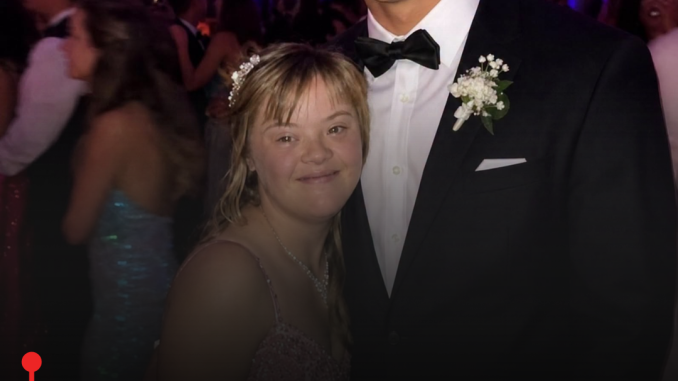
Rosie stood in our kitchen practicing the same dance step over and over, her silver shoes tapping softly against the tile.
“One-two-three, turn,” she whispered, completely focused.
I sat at the table with a cup of tea that had gone cold, watching her.
“Mom, am I doing it right?” she asked.
“You’re doing it perfectly,” I told her.
She smiled, satisfied.
Rosie has mosaic Down syndrome. Most people didn’t notice it right away, but at school, other kids always seemed to notice that she was different. And sometimes, they made sure she knew it too.
At first, it was little things.
A torn sleeve she claimed had caught on a locker. A stuffed bear that came home covered in marker. Quiet tears she quickly wiped away whenever I walked into the room.
Whenever I asked how school was, she gave me the same answer.
“Fine.”
Always fine.
Now prom was approaching.
And Rosie wasn’t just going.
She had been asked.
By Steven Parker, the school’s star quarterback.
Three weeks earlier, he had appeared at our front door holding a single white tulip.
He looked directly at Rosie and asked, “Would you go to prom with me?”
I was so shocked that I answered before I caught myself.
“Yes.”
Then I stepped aside and let Rosie make the decision.
She said yes.
My sister called it a miracle. She said Rosie deserved a night where she could simply feel special.
I wanted to believe her.
But one question kept bothering me.
Why Rosie?
Why would someone as popular as Steven, a boy everyone seemed to admire, choose my daughter?
I couldn’t completely shake the doubt.
“Mom?”
Rosie pulled me from my thoughts.
“You’re making your worried face again.”
“What worried face?”
“The one where your eyebrows do that thing.”
I laughed softly.
“Come here. Let’s get you ready.”
A little later, I helped her into a pale blue gown. She slowly turned in front of the mirror.
For a moment, every fear disappeared.
She looked beautiful—not because of the dress or the careful styling, but because she was genuinely happy.
“Do I look like a princess?” she asked.
“Yes,” I said. “You really do.”
Her smile said everything.
The gym looked completely different that night.
Blue and silver decorations covered the walls. Soft lights glittered across the ceiling, and music played as students laughed, danced, and took pictures.
Rosie stayed beside me at first, holding my hand tightly.
Then Steven walked in.
The room seemed to notice him immediately.
Conversations paused. Heads turned.
But Steven didn’t stop to talk to anyone.
He walked straight toward Rosie.
He smiled, bowed slightly, and held out his hand.
“May I have this dance?”
Rosie’s face lit up.
“Yes.”
They walked onto the dance floor.
One-two-three, turn.
One-two-three, turn.
The exact steps she had practiced in our kitchen.
For those few minutes, everything felt perfect.
I almost let myself believe there was nothing to worry about.
Then Steven removed his jacket.
He placed it over a chair near my table before returning to the dance floor.
A few minutes later, the jacket slipped onto the floor.
I bent down to pick it up.
That’s when I noticed something inside the inner pocket.
A flash drive.
A thick envelope.
And a stack of photographs.
Written across the envelope in dark marker were four words:
AFTER THEY LAUGH.
My stomach dropped.
I looked around before pulling out the photographs.
The first one showed Rosie sitting alone inside a bathroom stall, wiping tears from her face.
The second showed her holding a torn jacket, staring at the floor.
The third showed her sitting alone at a cafeteria table while several students laughed nearby.
My hands began to tremble.
Then I heard a quiet voice behind me.
“Don’t.”
I turned.
Steven was standing there.
The smile was gone from his face.
“Put them back,” he said quietly.
“Why do you have pictures of my daughter?”
“You need to trust me.”
“I don’t understand what this is.”
His voice remained calm.
“Please. Just wait.”
“If this is some kind of joke—”
“It isn’t.”
He looked toward the stage.
“Just wait for the announcement.”
Before I could stop him, he walked away.
Two of his teammates stepped in front of me.
“Give him a minute,” one said.
“No.”
“Please,” the other said. “Just trust him.”
Again, that word.
Trust.
Then Steven stepped onto the stage.
The music stopped.
Everyone turned toward him.
He picked up the microphone.
“Everyone, I need your attention.”
Rosie stood near the dance floor, looking confused.
Steven held up the flash drive.
“I wasn’t supposed to show this tonight,” he said.
Then he plugged it in.
The screen behind him came alive.
The first photograph appeared.
Rosie alone in the bathroom.
A wave of confusion moved through the crowd.
Then another photo appeared.
And another.
The room became quieter with every image.
But slowly, people began noticing something.
The same faces kept appearing in the background.
The same students.
The same girls.
Madison.
Brooke.
Caitlin.
Steven’s voice broke through the silence.
“For two years, I watched this happen.”
The crowd murmured.
“I asked them to stop.”
Another image appeared.
“They laughed.”
Another.
“We warned them.”
Another.
“They kept doing it.”
The gym fell completely silent.
Steven looked at everyone.
“Everyone sees Rosie,” he said.
“But nobody sees what happens when no one is watching.”
My throat tightened.
This wasn’t a prank.
It wasn’t some cruel prom stunt.
He had been documenting what was happening to my daughter.
He held up the envelope.
“This says ‘After They Laugh’ because that’s when most of these pictures were taken.”
Teachers began moving through the crowd.
Students who had been laughing moments earlier were suddenly looking at the floor.
Then Steven turned toward Rosie.
“I owe you an apology,” he said softly.
The room went silent.
“I should have done this sooner.”
Rosie looked overwhelmed.
Tears filled her eyes.
Steven stepped down from the stage and walked toward her.
Then he reached into his pocket.
This time, he pulled out a small velvet box.
Rosie gasped.
Inside was a silver bracelet with a tiny ballerina charm.
Her favorite.
“I read something I shouldn’t have read,” Steven said quietly.
Rosie’s hand went to her mouth.
“Your diary.”
A few students gasped.
“I know I shouldn’t have,” he continued. “But I saw what you wrote.”
He gently took her hand.
“You said you wished someone would watch you dance without laughing.”
His voice softened.
“You said you wanted to be brave like a ballerina.”
Tears rolled down Rosie’s cheeks.
Steven fastened the bracelet around her wrist.
“Tonight,” he said, “everyone is going to watch you dance.”
He paused.
“And nobody is going to laugh.”
For a moment, the entire gym was silent.
Then someone started clapping.
Another person joined.
Then another.
Within seconds, the entire room was on its feet.
Rosie looked around in disbelief.
“Mom,” she whispered.
“He saw me.”
Those three words broke my heart.
Because she was right.
Steven hadn’t seen a diagnosis.
He hadn’t seen a label.
He had seen Rosie.
Later, when everything had calmed down, I finally approached him.
“I’m sorry,” I said. “I thought you might hurt her.”
He shook his head.
“You’re her mom,” he replied. “That’s your job.”
Then he smiled.
“She made it easy to care.”
The music started again.
Steven held out his hand.
“May I have this dance?”
Rosie laughed through her tears.
“Yes.”
They stepped onto the dance floor.
One-two-three, turn.
One-two-three, turn.
The same steps she had practiced in our kitchen.
And for the first time in a long time, I stopped waiting for something terrible to happen.
Not because the world had suddenly become safe.
But because I remembered something I had almost forgotten.
Not everyone looks away.
Some people step forward.
And sometimes kindness doesn’t arrive with a grand announcement.
Sometimes it simply stands beside someone who has been hurt—and refuses to let cruelty have the final word.