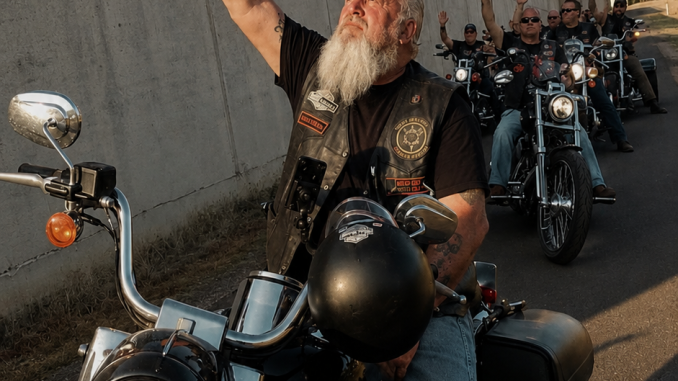
Every Friday at exactly 5 PM, they came.
Forty-three bikers.
They rode in a tight formation along the public road beside Redstone Correctional, their faces hidden behind dark helmets. They never stopped. They never shouted. They never played music.
They simply slowed down in front of the prison wall.
And then, in perfect unison, all forty-three raised one hand toward the razor wire.
Officer Dan Whitlock had spent nineteen years working at the prison. He had witnessed riots, protests, attempted escapes, and every kind of strange behavior imaginable.
But he’d never seen anything like this.
The first time it happened, the radio crackled immediately.
“Possible gang signal. All towers, stay alert.”
Guards moved inmates away from the windows. The warden nearly ordered a lockdown.
But the bikers did nothing.
After a few seconds, they lowered their hands, rolled on the throttle, and disappeared down the road.
The following Friday, they returned.
5 PM.
Same formation.
Same silence.
Same salute.
And the Friday after that.
The warden checked their license plates. Nothing. No warrants. No criminal connections. No known gang activity. The police found nothing either.
Legally, they were simply forty-three men riding motorcycles on a public road.
But Whitlock couldn’t stop wondering:
Why would anyone come to a prison every Friday just to salute a wall?
Then he noticed something nobody else had.
Every Friday, at exactly 5 PM, a seventeen-year-old inmate named Mateo Ruiz stood at a narrow window in C Block.
And every time the bikers raised their hands, Mateo cried.
The other prisoners assumed he was frightened.
He wasn’t.
He was remembering someone.
By the ninth Friday, Whitlock had enough.
He left the prison after his shift, drove to the access road in civilian clothes, and waited for the bikers.
When the familiar rumble finally approached, he stepped into the road and raised his hand.
The lead rider slowed.
“Nine weeks,” Whitlock said. “Nine weeks of this. You’ve scared half my staff and made the warden think we’re dealing with a gang.”
The rider said nothing.
“I’m not moving until you tell me why.”
For several seconds, the older man simply stared at him.
Then he removed his helmet.
Whitlock saw a silver beard and tired eyes.
The man’s eyes were already wet.
“You’ve got a boy in there,” he said.
“Mateo Ruiz?”
The biker nodded.
“What is he to you?”
The man looked toward the prison wall.
Then he raised his hand.
“That boy is the son of our brother.”
Whitlock frowned.
“Our brother?”
The biker swallowed hard.
“His father was one of us.”
He explained that Mateo’s father, Javier Ruiz, had been a member of their motorcycle club years earlier. But Javier wasn’t remembered because he was a biker.
He was remembered because of what happened on one terrible Friday afternoon.
A drunk driver had lost control of his car on a highway outside town. Javier saw the crash, stopped his motorcycle, and ran toward the wreckage.
He pulled two strangers from the vehicle before emergency crews arrived.
Then he went back for a third person.
He never came out.
Javier died trying to save someone he’d never met.
Mateo was only ten years old.
“His father used to meet us here every Friday,” the old biker said. “5 PM. He’d bring Mateo with him when the boy was little. They’d stand outside the club house, and we’d all salute Javier before we rode out.”
Whitlock looked at the prison wall.
“But why here?”
The biker’s voice broke.
“Because Javier was buried on a hill behind this prison. Mateo can see the top of it from that window.”
Whitlock was silent.
“Mateo’s mother died a few years later,” the biker continued. “He had nobody left. He made one terrible mistake. He was seventeen when he got arrested.”
The old man lowered his eyes.
“We can’t get inside. We can’t change what happened. We can’t give him his father back.”
He paused.
“But we can make sure he knows somebody still remembers him.”
Whitlock finally understood.
Every Friday at 5 PM, forty-three men weren’t saluting the prison.
They were saluting Javier.
And they were reminding his son that his father had not been forgotten.
The next Friday, Whitlock stood in Tower 3.
At exactly 5 PM, the familiar rumble came down the road.
Forty-three motorcycles.
Forty-three men.
The formation slowed.
Then every biker raised a hand toward the wall.
But this time, something was different.
Whitlock didn’t order the inmates away from the windows.
He didn’t call for a lockdown.
Instead, he walked to C Block and opened Mateo’s cell door.
“Come on,” he said.
Mateo looked confused.
“Where?”
“There’s something you need to see.”
Whitlock led him to the window.
Outside, the bikers were waiting.
Mateo’s face changed instantly.
Tears filled his eyes.
The old biker saw him.
For the first time in nine weeks, he removed his helmet completely.
Mateo raised his hand.
The old man raised his.
Then the other forty-two bikers followed.
No engines revved.
No words were spoken.
Just forty-three hands raised toward a seventeen-year-old boy behind a prison wall.
Mateo pressed his palm against the glass.
Whitlock stood beside him.
“Why do they keep coming?” Mateo whispered.
Whitlock looked at the bikers and answered:
“Because your father mattered.”
Mateo began to cry.
Outside, the bikers slowly lowered their hands and rode away.
But the following Friday, at exactly 5 PM, they came back.
And this time, Mateo was already standing at the window.
Waiting for them.
Because sometimes a person doesn’t need someone to open the prison door.
Sometimes they just need to know that the world outside hasn’t forgotten their name.