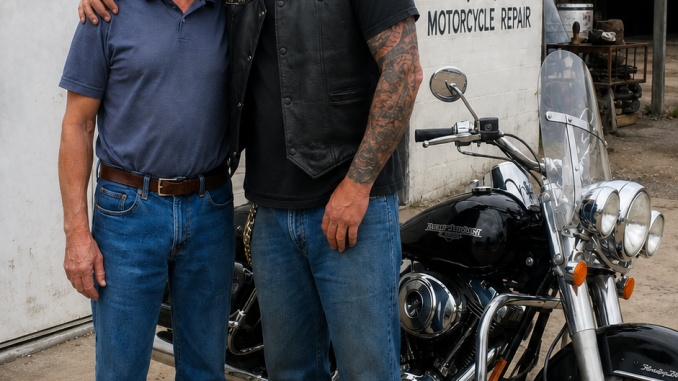
This biker gave me his kidney. I was the judge who sentenced him to fifteen years in prison. And even now, I still don’t know if what I did was truly justified.
My name is Robert Brennan. I served as a district court judge for twenty-eight years. In that time, I sentenced hundreds—maybe thousands—of people. I always believed I followed the law. I believed I was fair. I did my job.
One of those people was Michael Torres.
I sentenced him back in 2008 for armed robbery. He had walked into a convenience store holding a gun, demanded cash, took $347, and ran. Police found him six blocks away, sitting on a curb, crying.
He was twenty-four. It was his first offense. His girlfriend was pregnant. He had been unemployed for months and was about to be evicted.
The gun wasn’t even loaded. He told the cashier that during the robbery, saying, “I’m not going to hurt you, I just need the money.” He even apologized while it was happening.
The prosecutor pushed for the maximum sentence, saying it would send a message. I agreed.
Twenty years.
When I read the sentence, Michael broke down crying. He kept saying he was sorry, that he had made a mistake.
But the law didn’t consider apologies. He had used a weapon, and the mandatory minimum was fifteen years. I gave him twenty.
After that, I moved on. When you sentence enough people, they stop being people. They become files, numbers, cases.
I forgot about Michael—until last year, when my kidneys failed.
It was polycystic kidney disease, genetic and unavoidable. I had about six months without a transplant.
No family matched. No friends matched. I went on the transplant list and waited.
Four months later, the hospital called. A living donor had volunteered. He wanted to remain anonymous until after the surgery.
I didn’t ask questions. I was running out of time.
At 5 a.m., they prepared me for surgery. As I was being wheeled toward the operating room, I passed room 412 and glanced inside. A man on a gurney looked back at me—bald, tattooed arms, a leather vest folded nearby.
For a moment, something about him felt familiar.
Then I was put under.
I woke up fourteen hours later with a new kidney.
“Can I meet my donor?” I asked.
“He left two hours after surgery,” the nurse said. “Against medical advice. But he left this.”
She handed me an envelope. Inside was a copy of a court document—my signature at the bottom.
It was the sentencing order for Michael Torres.
Across the top, written in blue ink, it said: “Now we’re even.”
My daughter Rebecca found me staring at it.
“Dad, why would he do that? You sent him to prison.”
“I don’t know,” I told her.
I spent days recovering, getting stronger thanks to a kidney from the man I had once sentenced. The doctors said the match was unusually perfect—almost like we were related.
We weren’t. We were just judge and defendant, connected by a ruling and something harder to explain.
Once I was discharged, I hired a private investigator. It didn’t take long.
Michael had been released eight months earlier. He worked at a motorcycle repair shop called J&M, lived above a laundromat, and rode with a small biker group on weekends. He had stayed clean, followed parole, and kept a steady job.
I went to see him.
When I walked into the shop, a young worker went to get him. Michael came out a minute later, thinner than I remembered, tattoos covering his arms, grease on his clothes.
He stopped when he saw me.
“Judge Brennan.”
“Michael.”
We met across the street in a diner, sitting in a corner booth with cheap coffee.
“How are you feeling?” he asked.
“Strong. The kidney is working well.”
“Good.”
Then I asked him why he did it.
He stirred his coffee slowly. “You read the note.”
“‘Now we’re even.’ I don’t understand that. I took fifteen years of your life. You gave me a kidney. That isn’t equal.”
“Isn’t it?” he said calmly. “You took fifteen years. I gave you the rest of your life. Sounds even to me.”
“You should hate me.”
“I did,” he admitted. “For years. I couldn’t sleep. I replayed everything.”
“And then?”
“I met someone inside who had been serving life. He told me hatred only destroys you. Like poison you drink yourself.”
He paused. “It took time, but I let it go.”
“So why help me?”
“After I got out, I signed up to be a donor. Then one day I saw your name on the list.”
“You still chose to go through with it.”
“I thought about it for days,” he said. “Then I realized I was finally in a position where I had a choice. Inside prison, I had none. This time I did.”
He leaned back. “You used your power to give me twenty years. I used mine to give you life. That’s how I saw it balanced.”
“Why leave before I woke up?”
“Because I didn’t want gratitude. I didn’t do it for thanks. I did it because it was the right thing—and then I left.”
I sat there, facing the man I once condemned, and he was the one showing me something close to forgiveness.
“I’m sorry,” I finally said. “I could have shown more mercy.”
“You couldn’t have known everything,” he replied.
“I remember you apologizing three times during the robbery.”
“I also scared someone and robbed a store,” he said. “Choices have consequences.”
That was almost a year ago.
Now I visit his shop weekly. At first I pretended I wanted a motorcycle. Eventually, we stopped pretending.
Michael now hires ex-cons and people nobody else will give a chance. He trains them, gives them structure, and expects accountability.
“I know what it’s like to start over with nothing,” he told me once.
I also started working with a re-entry program, helping former prisoners rebuild their lives. Trying to do for others what I wish I had done better before.
Last week, I asked him if he regretted giving me his kidney.
“No,” he said. “But I wonder what you’ll do with it.”
“What do you mean?”
“I gave you more time. What are you going to do with it?”
I’ve been thinking about that ever since.
He walked into a store once with a loaded moment of desperation and left with a sentence that changed both our lives. I gave him twenty years. He gave me a second chance at life—and a question I can’t ignore.
What am I going to do with this gift?
I’m going to see people again—not cases, not files. Human beings.
Because justice without mercy becomes something else entirely. And sometimes, the people we judge are the ones who end up teaching us the most about grace.