In eleven years working as a cashier, I thought I had seen it all.
I’ve watched people argue over coupons, rush through lines without a word, and struggle when their cards were declined. I’ve seen frustration, disappointment, and every kind of human behavior imaginable.
But I had never cried at work.
Until last Tuesday.
My name is Rebecca. I’m 34 years old, and I work the morning shift at a grocery store in South Georgia. Most mornings are quiet—retirees picking up a few essentials, parents shopping with young children, and truck drivers stopping in for coffee before hitting the road.
Around 9 a.m., an elderly woman stepped into my checkout line.
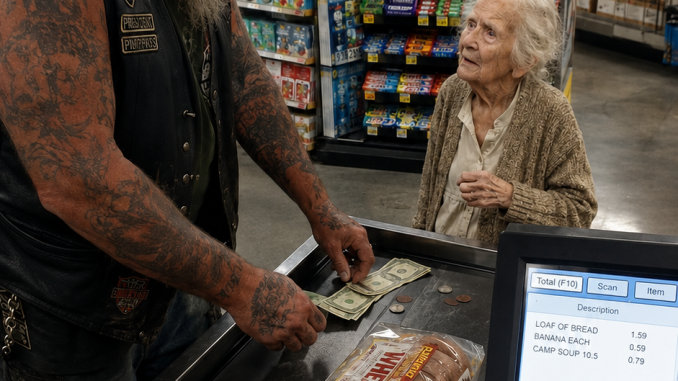
She was tiny, frail, and moved carefully. Her white hair was thin, and her worn cardigan looked decades old. As she placed her groceries on the belt, her hands trembled.
A loaf of bread.
A can of soup.
One banana.
Just enough food to get through another day.
Standing behind her was a man who immediately caught my attention.
He was huge. Covered in tattoos from his neck to his wrists. His gray beard reached his chest, and he wore a leather biker vest decorated with patches and symbols I didn’t recognize.
To be honest, he looked intimidating.
The woman’s total came to $4.27.
She opened a small coin purse and slowly began counting change onto the counter. Pennies, nickels, and a few dimes rolled from her shaking fingers.
“Take your time, ma’am,” I told her.
After several minutes, she had only managed to count $3.84.
She searched through her purse again.
Nothing.
Her expression collapsed.
“I’m sorry,” she whispered.
She removed the banana.
Then the soup.
Even after that, she was still short.
Tears filled her eyes.
“I thought I had enough.”
The entire store seemed to pause.
Then the biker stepped forward.
I instinctively tensed, expecting impatience or frustration.
Instead, he gently placed a hand on her shoulder.
“Ma’am,” he said softly, “your son sent me today.”
The woman froze.
“My son? Michael?”
The biker nodded.
“Michael. From the VA hospital.”
Her face turned pale.
“Michael passed away three years ago.”
“I know,” he replied quietly. “I was there when he died. He asked me to look after you.”
The line fell completely silent.
“He talked about you all the time,” the biker continued. “About how hard you worked to raise him. About how you sacrificed everything for him. About your cooking. About the songs you sang to him when he was a boy.”
The woman’s eyes filled with tears.
“You knew my Michael?”
The biker swallowed hard.
“He was one of the best men I’ve ever known.”
Then he pulled out his wallet and placed two hundred dollars on the counter.
“Michael wanted you to have this.”
She stared at the money.
Then at him.
Finally she asked, “That’s not really from Michael, is it?”
The biker smiled gently.
“No, ma’am. It’s from me. But I think he’d want me to give it to you.”
The woman burst into tears.
Without hesitation, she wrapped her arms around him.
The giant biker hugged her back as if she were his own mother.
Around us, people were wiping away tears. Customers. Employees. Even the stock clerk standing nearby looked emotional.
The woman—whose name was Dorothy—left that day with a cart full of groceries. The biker paid for everything, helped her load her car, and followed her home to make sure she arrived safely.
The next day, he came back.
He found me at my register and said something I never expected.
“I need to apologize.”
“For what?” I asked.
“For lying.”
He explained that he had never actually met Michael.
A few days earlier, someone at a VA hospital had mentioned an elderly mother struggling on her own after losing her son.
So he started asking questions.
He spoke with people who knew Michael.
He learned about Dorothy.
He listened to stories.
He memorized details.
Then he walked into that grocery store and told a grieving mother exactly what she needed to hear.
“Was it wrong?” he asked me quietly. “I just wanted her to feel like her son was still watching over her.”
I thought about Dorothy’s smile as she left the store.
The first genuine smile anyone had seen from her in years.
“No,” I finally answered. “I think it helped.”
That biker’s name was Thomas.
And that wasn’t the end of the story.
Eight months later, Thomas still visits Dorothy every Sunday.
He drives her to Michael’s grave.
He brings flowers.
He sits beside her while she talks to her son.
Then they go to lunch together.
His motorcycle club has repaired her roof, fixed things around her house, and helped whenever she needed support.
What began as a stranger’s act of kindness became something much bigger.
A family.
Last week Dorothy came through my checkout line again.
She smiled and told me something I’ll never forget.
“I’m not afraid anymore,” she said. “I have sons again.”
Then she laughed.
“They’re loud, covered in tattoos, and a little rough around the edges—but they’re my sons.”
Later, I asked Thomas why he continues to do all of this.
His answer was simple.
“Because she’s family now.”
For eleven years, I believed I understood people.
I thought kindness looked a certain way.
I thought compassion came from certain kinds of people.
Thomas taught me otherwise.
Kindness doesn’t wear a uniform.
It doesn’t care about appearances.
Sometimes it looks like a biker in a leather vest placing money on a checkout counter.
Sometimes it looks like Sunday visits to a cemetery.
Sometimes it looks like showing up for someone who thinks the world has forgotten them.
And sometimes, it begins with six simple words:
“Ma’am, your son sent me today.”