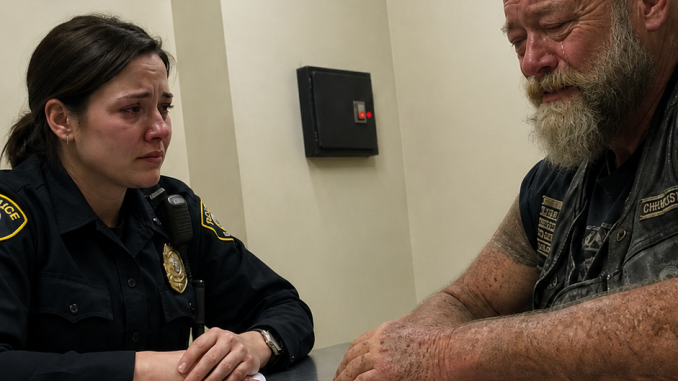
Officer Sarah Chen pulled me over on Highway 49 for a broken taillight. The moment she stepped up to my bike, my heart nearly stopped.
She had my mother’s eyes. My nose. And beneath her left ear was a small crescent-shaped birthmark I remembered kissing goodnight when she was a little girl.
My daughter.
The daughter I hadn’t seen in thirty-one years.
“License and registration,” she said calmly.
Her voice was professional, distant. She had no idea who I was.
My hands trembled as I handed over my documents. Robert “Ghost” McAllister. The name meant nothing to her. Long ago, her mother had made sure of that.
But I recognized everything.
The way she shifted her weight onto one leg. The faint scar above her eyebrow from a childhood fall. The habit of tucking her hair behind her ear when she concentrated.
“Mr. McAllister, please step off the motorcycle.”
She didn’t know she was arresting her own father.
My daughter, Sarah Elizabeth McAllister, disappeared on March 15, 1993.
After my divorce from her mother, Amy, we shared custody without major problems. Then Amy met a man named Richard Chen, who could offer the stability I never could as a biker trying to make ends meet.
One Friday, I arrived to pick up Sarah for the weekend.
The apartment was empty.
No note. No forwarding address. Nothing.
I filed reports, hired investigators, and spent every dollar I had searching. The courts ruled Amy had violated custody agreements, but nobody could find her. She had vanished completely.
For three decades, I searched.
Every crowd, every airport, every charity event, every city I rode through—I looked for my little girl.
My brothers in the Sacred Riders motorcycle club searched too. We carried her photograph everywhere. We never gave up.
That night, standing beside Highway 49, I realized I had finally found her.
Unfortunately, she thought I was a threat.
“I smell alcohol,” Officer Chen said.
“I haven’t had a drink.”
She ordered a field sobriety test.
I understood why. I couldn’t stop staring at her. My hands were shaking. Any officer would have been suspicious.
At the station, they ran every test imaginable.
Breathalyzer: 0.00.
Completely sober.
When Officer Chen returned, I asked quietly, “Can I show you something? There’s a photograph in my vest.”
After checking my pockets, she found it.
The moment she saw the picture, her expression changed.
It was a photo of a two-year-old girl sitting on my Harley-Davidson, wearing a tiny oversized biker vest and smiling at the camera.
My daughter.
Her.
“Where did you get this?” she asked.
“Because that’s my daughter,” I answered. “Sarah Elizabeth McAllister. Born September 3, 1990. Eight pounds, two ounces. Her first word was ‘vroom.'”
She stared at me in silence.
Then she whispered, “My name is Sarah Chen. I was adopted when I was three years old.”
The room suddenly felt very small.
“My parents told me my biological parents died in a motorcycle accident.”
For thirty-one years, she’d believed I was dead.
I told her everything.
Her mother’s name.
The scar on Amy’s hand.
The songs she used to sing.
The details nobody else could possibly know.
Sarah listened, tears filling her eyes.
Finally she said, “You’re lying.”
“Then let’s do a DNA test.”
Hours later, she returned.
This time she was crying.
“They admitted it,” she whispered.
Her adoptive parents confessed that Amy had brought her to them years earlier, claiming I was dangerous. After Amy died in a car accident, they continued raising Sarah and never told her the truth.
The lies had lasted three decades.
Neither of us knew what to say.
We sat there across the table—an officer and a biker, strangers connected by blood.
“I don’t know how to do this,” she admitted.
“You don’t have to,” I said. “We’ll take it one day at a time.”
Then she showed me a photo on her phone.
Two little boys smiled back at me.
“My sons,” she said.
My grandsons.
For a moment, thirty-one years of pain disappeared.
The DNA results later confirmed everything.
Rebuilding our relationship wasn’t easy. Sarah still loved the family who raised her, and I respected that. They had given her a good life, even if they had hidden the truth.
When my brothers from the Sacred Riders finally met her, grown men cried openly.
One brought thirty-one birthday cards he had saved—one for every year she was gone.
Another had spent years buying toys and gifts, refusing to believe she would never come home.
Today, Sarah’s boys love motorcycles.
She still worries whenever they’re around bikes, but she trusts me enough to teach them about responsibility, loyalty, and honor.
A few months ago, Sarah visited our clubhouse in full police uniform.
Standing before twenty-seven bikers who had spent decades helping me search, she said:
“I was raised to fear people like you. I was taught that bikers were dangerous. But you never stopped looking for me. You never stopped believing. You’re my heroes.”
Not a single man in that room had dry eyes.
Now, sometimes Sarah and I ride together.
She rides her department motorcycle.
I ride my old Road King.
Most of the time, we don’t say much.
We don’t need to.
Last week, my grandson Tyler asked me why everyone calls me Ghost.
I smiled and looked at Sarah.
“Because for thirty-one years,” I told him, “I was haunting someone who didn’t know I existed.”
“But ghosts aren’t real,” he said.
“No,” I replied.
Then I watched my daughter laugh with her sons—the family I thought I’d lost forever.
“No, son. But miracles are.”