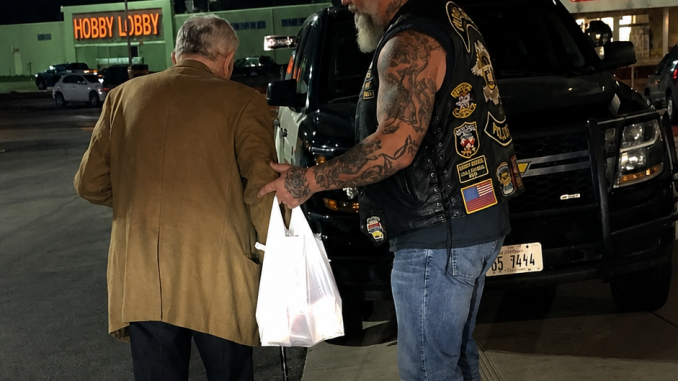
The old man spit on me and called me a criminal, but I still carried his groceries to his car.
He had to be around eighty-five, maybe older. One hand gripped a cane, the other clutched a plastic grocery bag that looked ready to tear open at any second. He was moving slowly across the parking lot, each step looking harder than the last.
I saw the bag stretching at the bottom, and without thinking, I stepped closer.
“Sir, let me help you with that.”
He turned toward me like I had insulted him.
“Get away from me,” he snapped. “I know what you people are. Thugs. Criminals. You’re not getting my wallet.”
I froze.
“I’m not trying to rob you,” I said calmly. “Your bag is ripping. I just want to help you get to your car.”
Then he spit at me.
It landed on my leather vest, right over my Vietnam Veteran patch.
“I don’t need help from people like you,” he growled. “I was a Marine. I fought for this country. Men like you are what’s ruining it.”
People nearby started staring. A woman pulled her children closer. A man across the lot reached for his phone, probably thinking he was about to witness some kind of confrontation.
I should have walked away.
Most people would have.
But I noticed his shaking hands. I noticed how badly his legs trembled. I noticed the prescription bottles sticking out from the top of his bag.
And then I noticed the Marine Corps ring on his finger.
“I served too, sir,” I said quietly. “Army. Three tours in Vietnam. Came home in ’71.”
He stopped.
Slowly, he turned back around. His eyes narrowed, but this time there was something different behind them.
“You’re lying,” he said. “Men like you don’t serve. Men like you take.”
“My name is Robert Chen,” I replied. “Sergeant First Class. 101st Airborne Division. Screaming Eagles.”
For the first time, he looked at my vest instead of my face. He saw the flag patch. The POW/MIA emblem. The airborne insignia that had been stitched there for decades.
“Airborne?” he asked, softer now.
“Yes, sir.”
He stared at me for a long moment.
“Then why do you dress like that?” he asked. “Like some gang member?”
I looked down at my vest.
“Because these men are my brothers now,” I said. “Just like the Marines were yours. Some of us came home broken. This club helped put us back together.”
His hand tightened around the cane.
“My son came home broken,” he whispered. “Iraq. 2007.”
My expression changed immediately.
“Is he okay?”
The old man looked away. His face hardened, but not fast enough to hide the pain.
“He took his own life three years later,” he said. “Couldn’t get help from the VA. Couldn’t get help from anybody.”
The parking lot suddenly felt colder.
“I’m sorry,” I said. “I truly am.”
“Don’t be sorry,” he muttered. “Just leave me alone.”
He started walking again, slower than before. The bottom of the bag was almost gone. A carton of milk was about to fall through.
So I followed him.
Not too close. Just close enough to catch him if he fell.
“I told you to leave me alone,” he barked without looking back.
“I can’t do that, sir.”
That made him stop.
When he turned around, anger flashed across his face again. He shoved my chest with one weak hand.
“I don’t need pity from you.”
The push barely moved me, but the effort nearly knocked him off balance. His cane slipped on the pavement.
I caught him before he fell.
For a second, he gripped my arm like his life depended on it.
Then the grocery bag finally tore open.
Milk, bread, and a bottle of pills hit the ground.
The old man looked down at everything scattered across the pavement, and something inside him seemed to break.
He covered his face with one trembling hand.
“I’m tired,” he whispered. “I’m just so tired.”
No one in the parking lot said a word.
I bent down, picked up his groceries, and placed them carefully into my own bag from my motorcycle. Then I handed it to him.
He didn’t take it.
Instead, he looked at the patch on my vest again.
“My boy had a jacket,” he said quietly. “Not like yours. Military one. He wore it everywhere after he came home.”
I nodded.
“Sounds like he was proud.”
“He was hurting,” the old man said. “And I didn’t know how to help him.”
His voice cracked on the last word.
That was the moment I understood. His anger wasn’t really about me. It wasn’t about bikers, tattoos, leather, or patches.
It was grief.
Raw, old, untreated grief.
The kind that turns into bitterness when it has nowhere else to go.
“What was his name?” I asked.
The old man looked at me.
“Daniel.”
I lowered my head.
“Then let me help you, sir. Not because you need pity. Because Daniel would want someone to make sure his father got home safe.”
His eyes filled with tears, but he quickly blinked them away.
For the first time, he let me carry the bag.
We walked slowly to his car. I opened the door, placed the groceries inside, and helped him sit down. He sat there for a moment with both hands on the steering wheel, staring straight ahead.
Then he said something I never expected.
“I’m sorry I spit on you.”
I wiped my vest with my sleeve and gave him a small smile.
“I’ve had worse happen to this vest.”
He almost laughed.
Almost.
Before I stepped away, he reached into his coat pocket and pulled out an old folded photograph. It showed a young man in uniform, smiling wide, one arm around the same old man who had just called me a criminal.
“That’s Daniel,” he said.
I looked at the photo carefully.
“He had kind eyes.”
The old man nodded.
“He did.”
Then he looked back at me.
“Robert?”
“Yes, sir?”
“Do you think your club ever talks to fathers? Not just veterans. Fathers who lost veterans.”
I swallowed hard.
“We do now.”
Three days later, he showed up at our clubhouse.
He was still using the same cane. Still stubborn. Still suspicious of everyone at first.
But he brought Daniel’s photograph with him.
He sat with us for two hours and barely spoke. Then one of our younger Iraq vets sat beside him and said, “Tell me about your son.”
And the old man did.
He talked until his voice gave out.
After that, he came every Thursday.
He never became a biker. Never wore leather. Never stopped being difficult.
But he stopped being alone.
And every week, before he left, he would tap my Vietnam patch with two fingers and say, “Thank you, Sergeant.”
People see a vest and think they know the man wearing it.
They see tattoos, motorcycles, scars, and patches, and they decide the story before hearing a single word.
But sometimes the person you fear is the one who refuses to leave you behind.
And sometimes kindness doesn’t look soft.
Sometimes it looks like a tattooed old soldier standing in a parking lot, wiping spit off his vest, and choosing compassion anyway.