Imagine stepping outside on a peaceful afternoon, coffee in hand, while the evergreen trees in your yard sway gently in the breeze. Everything feels calm, familiar, and unchanged—the kind of scenery you stop noticing because it has always been there.
But then, something catches your eye.
At first, it seems minor. A few branches appear thinner than usual. The rich green color that once made your trees look healthy and full now seems patchy in certain areas. You move a little closer, convincing yourself it’s probably just the season changing.
Then you notice it.
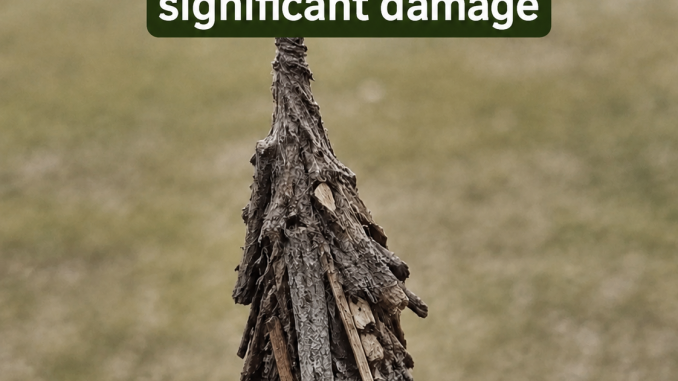
A strange object hanging from a branch. Not quite a leaf. Not exactly a nest. Something between a cocoon and a dried seedpod, swinging lightly in the wind as though it naturally belongs there.
But it doesn’t.
You lean in for a better look.
And suddenly, your quiet backyard feels different.
Because whatever that thing is, it definitely wasn’t there before.
And it looks carefully built.
What Are Evergreen Bagworms?
What you’ve likely found is an evergreen bagworm—a surprisingly destructive insect capable of causing serious damage before most homeowners even realize there’s a problem.
Bagworms are difficult to notice. They don’t swarm visibly across branches or destroy trees overnight. Instead, they work slowly and quietly, blending into the environment around them.
During their larval stage, bagworms create protective cases using silk mixed with pieces of the very tree they are feeding on. These hanging “bags” are carefully disguised to resemble natural parts of the tree.
From a distance, they can easily look like pinecones, dead foliage, or harmless debris.
That camouflage is exactly what makes them dangerous.
Why Bagworms Are So Harmful
Evergreen trees are often considered strong and low-maintenance. People plant them for privacy, shade, and year-round greenery, assuming they’ll remain healthy with little attention.
Bagworms take advantage of that confidence.
Once attached to a tree, the larvae begin feeding on the needles little by little. The damage is gradual, making it easy to overlook in the early stages.
At first, you may notice slight thinning or uneven color. Over time, however, branches weaken, foliage becomes sparse, and the once vibrant tree starts looking stressed and unhealthy.
By the time many homeowners recognize the problem, the infestation has already spread significantly.
And the tree is no longer simply struggling—it’s trying to survive.
What’s Inside Those Hanging Bags?
Those strange dangling structures are not harmless growths or abandoned cocoons.
Inside each one is a living bagworm larva protected within its portable shelter. As the insect grows, it continuously adds new layers of silk and plant material to expand the bag.
This allows the insect to remain hidden while feeding directly on the tree itself.
The tree becomes both its shelter and its food source.
And because the camouflage is so effective, most people don’t notice the infestation until the population has already multiplied.
What Bagworms Eventually Become
Bagworms eventually transform into moths.
Adult males emerge as small winged moths, while females often remain inside the protective bag for most of their lives.
After mating, the female lays hundreds of eggs inside the same structure she once lived in. What looked like a harmless piece of debris suddenly becomes an egg-filled capsule waiting for the next generation to hatch.
And when they do, the cycle starts all over again.
Not with just a few insects.
But sometimes with hundreds.
Why Infestations Spread So Quickly
One of the biggest problems with bagworms is how quietly they spread. Since they blend so naturally into evergreen trees, infestations often go unnoticed for long periods of time.
Wind can carry young larvae from one tree to another, allowing the problem to spread across entire rows of landscaping before anyone realizes what’s happening.
By the time obvious damage appears, multiple trees may already be affected.
That’s why bagworms are often described as a “silent threat.”
Not because they are invisible—but because they are so easy to ignore.
How Homeowners Usually Remove Them
If caught early, bagworms can sometimes be controlled with manual removal. Many homeowners simply pick the bags off branches and dispose of them carefully before the insects continue developing.
Pruning damaged branches may also help prevent the infestation from spreading further.
Some people use mild soapy treatments or natural solutions during the early larval stages. In more serious infestations, professional or chemical treatments may be necessary, especially once the population becomes widespread.
Timing is extremely important, since treatments work best when the larvae are still young and actively feeding.
The Long-Term Damage
Even after bagworms are removed, the effects on evergreen trees can last for years.
Evergreens recover slowly, and severe infestations may permanently weaken the tree’s health and appearance. Loss of needles affects not only the look of the tree, but also its ability to handle environmental stress and future pests.
This is why early detection matters so much.
What appears to be a small hanging object can eventually determine whether a tree fully recovers—or continues to decline.
Why So Many People Miss the Warning Signs
Most people expect serious problems to announce themselves clearly. Dead branches, swarms of insects, or dramatic color changes are the warning signs homeowners are used to seeing.
Bagworms don’t behave that way.
They stay hidden. They blend in. They slowly damage the tree while looking like part of it.
And by the time the threat becomes obvious, the damage is often already well underway.
Final Thoughts
Evergreen bagworms may be small, but the damage they cause can be enormous. Their greatest advantage is how naturally they disappear into the trees they are destroying.
They remind us that some threats don’t arrive loudly. Sometimes damage happens quietly, little by little, until the consequences finally become impossible to ignore.
And in the end, the healthiest trees are often the ones someone noticed early enough to protect.