For three years, I thought the biker was Death itself.
That sounds dramatic, I know. But if you had seen him the way we did — always appearing at the exact moment someone was about to take their last breath — you might have believed it too.
His name was Thomas.
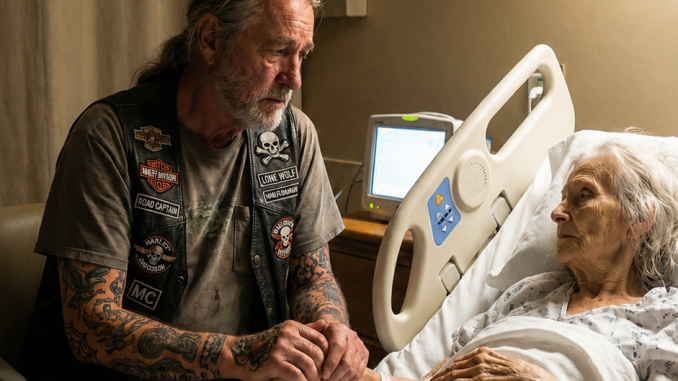
Tall. Weathered. Gray beard hanging to his chest. Heavy leather vest covered in faded patches from motorcycle clubs nobody recognized. Tattoos wrapped around both arms like old war stories written into skin. Boots that echoed through the hospice hallway like thunder in a church.
And somehow… he always knew.
Every patient who was dying alone.
Every single one.
I’m Claire Matthews, a hospice nurse for nearly twelve years. I’ve held more hands during final moments than I can count. I’ve watched families say goodbye through tears, prayers, anger, guilt, and silence.
But the deaths that stayed with me were always the lonely ones.
The patients abandoned in their final days.
The ones who stared at the ceiling because nobody came.
The ones who kept asking, “Did my daughter call?” even after weeks without a phone ringing once.
Those were the deaths that broke me.
And Thomas seemed to appear for all of them.
The first time I saw him was Room 412.
Margaret Chen. Ninety-one years old. Tiny woman. Former piano teacher. No visitors in over six months. Her chart listed a son in California, but every number we called went straight to voicemail.
She had hours left.
I remember dimming the lights and pulling a chair beside her bed because nobody deserves to die alone.
Then I heard the boots.
Slow. Heavy. Calm.
I turned around expecting security to stop whoever was coming down the hall. Instead, this massive biker stepped quietly into the room like he belonged there.
He nodded once at me.
Then he sat beside Margaret, took her frail hand gently into his massive tattooed one, and whispered:
“You don’t gotta be scared anymore.”
I stood up immediately.
“Excuse me? Family only beyond this point.”
He looked at me with eyes so tired they almost hurt to look at.
“She doesn’t have family,” he said softly. “That’s why I’m here.”
“How do you even know her?”
No answer.
He simply turned back toward Margaret and kept talking to her like she mattered more than anything else in the world.
He told her she wasn’t forgotten.
That someone was with her.
That it was okay to rest.
Margaret passed away forty-seven minutes later.
Peacefully.
Holding his hand.
Thomas kissed her forehead afterward, stood up silently, and walked out of the room before I could stop him.
I immediately reported him.
My supervisor barely reacted.
“Oh,” she sighed. “That’s Thomas.”
“That’s Thomas? What does that even mean?”
She looked at me strangely.
“He’s been coming here for years.”
“Who is he?”
“Nobody really knows.”
That answer haunted me.
Over time, I started noticing patterns.
Whenever a patient had nobody left… Thomas appeared.
Sometimes at 2 a.m.
Sometimes during storms.
Sometimes after patients had specifically whispered they were afraid to die alone.
He never checked in at the desk.
Never asked permission.
Never caused problems.
He simply sat beside dying strangers and stayed until the end.
And somehow, administration allowed it.
I watched him sit with an old Vietnam veteran whose sons never answered the hospital’s calls.
I watched him sing softly beside a homeless man whose body was shutting down from liver failure.
I watched him pray with a teenage girl disowned by her parents after coming out as gay.
That one nearly destroyed me.
She was nineteen.
Terrified.
Her breathing shallow and uneven as machines beeped softly around her.
Thomas sat beside her for six straight hours while she cried about how her mother stopped loving her.
“You think God still wants me?” she whispered.
Thomas squeezed her hand gently.
“Kid,” he said, voice cracking, “God wanted you before anybody else did.”
She died an hour later with tears still drying on her cheeks.
I started becoming obsessed with him after that.
Because nobody does that for strangers.
Not consistently.
Not for years.
Not without a reason.
One night, I finally asked him directly.
“Why do you do this?”
He stared at the floor for a long time before answering.
“Because someone should’ve done it for her.”
“For who?”
But he stood up and left without another word.
That answer stayed buried for months.
Until Room 237.
An elderly man named Walter Briggs had been unconscious for almost a day when Thomas arrived. I was adjusting medication when Walter suddenly opened his eyes.
Not unusual.
Sometimes patients rally briefly before passing.
But what Walter said made my blood run cold.
“You,” Walter whispered weakly toward Thomas.
Thomas froze.
Walter’s face twisted with fear.
“No… no, not you…”
Thomas looked pale.
Then Walter began shaking violently.
“You took her away from me.”
The room went silent.
I stared at Thomas.
For the first time since meeting him, I saw genuine panic in his eyes.
Thomas stepped backward slowly.
But Walter kept staring at him like he’d seen a ghost.
“You don’t get to play hero now,” the old man whispered.
Thomas turned and walked out immediately.
That night, curiosity finally defeated professionalism.
I followed him.
He rode an old black Harley across town to a tiny house near the edge of the river. The place looked abandoned. Peeling paint. Broken porch light. Rusted mailbox.
I waited outside for almost twenty minutes before knocking.
Thomas opened the door looking exhausted.
“You shouldn’t be here,” he said quietly.
“I need answers.”
He stared at me for a long time.
Then finally stepped aside.
Inside the house were photographs.
Hundreds of them.
Every wall.
Every shelf.
Every table.
Pictures of women. Men. Elderly patients. Young patients.
All dead.
My stomach turned.
“What is this?”
Thomas looked devastated.
“They’re the ones who died alone.”
I felt cold all over.
“Why do you have pictures of them?”
He sat heavily in a chair.
“Because nobody else remembered them.”
I should’ve left then.
But I noticed one photo sitting apart from the others.
A young woman in her twenties with bright eyes and long dark hair.
Thomas saw me looking.
“That was my daughter,” he whispered.
Her name was Emily.
Three years earlier, she’d died alone in a hospital two states away after a drunk driver caused an accident.
Thomas hadn’t reached her in time.
Traffic.
Snowstorm.
Missed flights.
By the time he arrived, she was already gone.
No one had been sitting with her.
No one held her hand.
No one told her she mattered.
Thomas broke while telling me that part.
A grown man who looked carved from steel suddenly crying like a child.
“She was scared,” he whispered. “And nobody was there.”
That was the moment I finally understood him.
Thomas wasn’t Death.
He was a father trying to save strangers from the loneliness his daughter suffered.
But then he told me something else.
Something darker.
The reason Walter recognized him.
Years before Emily’s death, Thomas had been the drunk driver.
Not in Emily’s accident.
In another one.
A crash that killed a mother and left Walter’s daughter permanently disabled.
Thomas had served prison time. Lost everything. Alcohol destroyed his life afterward.
And Walter had recognized him from court nearly twenty years earlier.
“I spent half my life taking from people,” Thomas said quietly. “Now I spend whatever’s left giving something back.”
“Why hospice?” I asked.
He looked down at his shaking hands.
“Because nobody should leave this world believing they were abandoned.”
The next morning, Thomas was back at the hospice.
Room 510.
An elderly woman named Helen who had nobody left except late-stage dementia and fading memories.
He sat beside her holding her hand while sunlight spilled softly across the blankets.
And for the first time…
I sat beside him.