That evening, after Lily fell asleep, I sat alone in the dark living room. The TV was off. The house was quiet in that heavy way only a house with a sleeping child can be — the hum of the fridge, the soft click of the heat, and all the thoughts I had been avoiding pressing down on me.
I kept seeing Glenn’s hands wrapped around the handlebars. I kept seeing the way his head lowered when Sophie waved at him. Such a small nod. Almost nothing. Yet somehow, it felt like everything.
The next morning, Lily barely touched her breakfast.
“Daddy,” she asked, “is that man going to be there again today?”
“I think so,” I said.
“Is he a bad man?”
I looked at her little face. Seven years old. Kind eyes. Too young to understand court orders, grief, custody battles, or the way adults sometimes make painful choices.
“No,” I said softly. “He’s not a bad man. He’s just sad.”
“Can I wave at him again?”
Something inside me shifted.
“Yes,” I said. “You can wave.”
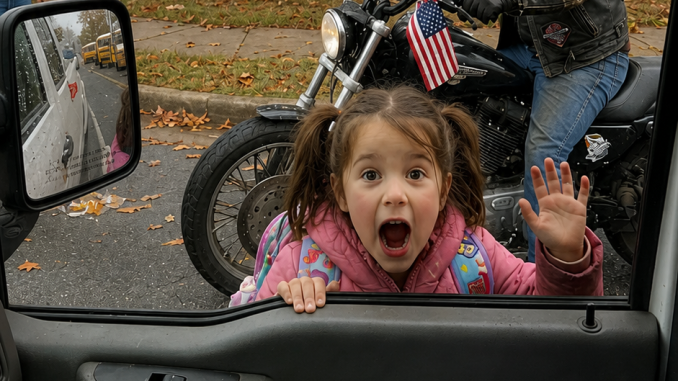
When we reached the school, Glenn was already there, parked beneath the oak tree like always. Lily rolled down the window and shouted across the road, “Morning, Mr. Glenn!”
For a second, he froze.
Then his head dipped in that same small nod.
But this time, I saw his jaw tremble.
Lily smiled like she had just given someone a gift.
And maybe she had.
That morning, I followed Glenn after school drop-off. I watched him ride to a small diner called Mabel’s Kitchen. I sat in my truck for several minutes before finally walking inside.
He was alone in a booth, hands around a cup of black coffee.
“Mr. Harwell?” I said.
He looked up. “Who’s asking?”
“My name is Kevin Marsh. My daughter is Lily. She goes to Ridgeway. She’s the one who yelled at you this morning.”
“I know,” he said quietly. “She yelled my name.”
I sat across from him and told him the truth.
“I owe you an apology.”
He listened as I admitted that I had misjudged him, that I had thought he was a threat, that I had nearly called the police.
Glenn didn’t get angry.
He just nodded like he was used to being misunderstood.
Then he told me about Christine, his daughter. About Sophie, his granddaughter. About how Christine died, how Sophie ended up with another family, and how the court decided Glenn couldn’t have contact because of mistakes he had made decades earlier.
“I don’t want to take her,” he said. “I just want to know she’s okay. I just want to see her walk inside safely.”
That was all he had been doing.
Every morning.
Rain or shine.
Not asking for anything. Not crossing the street. Not waving. Just showing up.
Later, I met David and Rachel Nolan, Sophie’s adoptive parents. They were good people. They knew who Glenn was. They knew he sat outside the school. And instead of calling the police, David sometimes brought him coffee.
They told me Sophie knew the man on the motorcycle was her grandfather. She wanted to hug him, but the court order wouldn’t allow it.
That broke something in me.
Lily broke it even more when she asked, “Daddy, can’t Sophie just hug him once?”
I didn’t know how to explain that sometimes rules are meant to protect children, but sometimes they accidentally hurt them too.
Over time, things began to change. Lily waved at Glenn every morning. Then other kids did too. Parents who had once been nervous began to understand. Glenn never waved back, because he was afraid of breaking the rules, but he nodded every time.
And every time, it looked like it cost him everything not to cry.
Eventually, David and Rachel decided to fight for Glenn. Their lawyer filed a petition for supervised visitation. Parents from the school gave statements. The crossing guard testified that Glenn had never caused trouble. I testified too.
I told the judge that I had once seen Glenn as a threat.
And now I saw him as one of the most loyal men I had ever met.
“Your Honor,” I said, “I know what abandonment looks like. Glenn Harwell is the opposite of that. He showed up every morning for years, even when no one thanked him, even when no one understood. If that isn’t love, I don’t know what is.”
Glenn took the stand and told the truth.
He admitted his past. He admitted his mistakes. He said he had been sober for twenty-two years. He said he wasn’t trying to replace Sophie’s family. He only wanted to be allowed to love her openly.
Two weeks later, the ruling came.
Supervised visitation was approved.
Two hours every other weekend.
It wasn’t much.
But it meant Sophie could finally hug her grandfather.
The first photo David sent me showed Glenn and Sophie sitting together at a small table. Sophie was showing him a drawing of a motorcycle under an oak tree. Glenn was crying. Sophie’s hand rested on his arm.
When I showed Lily, she looked at the photo and simply said, “Good.”
And it was good.
After that, Glenn still came to the school every morning. Only now, when Sophie passed by, she could call him “Papa.”
The first time she did, Glenn took off his sunglasses and cried right there on the street.
No one looked away.
Spring came. The oak tree turned green again. Glenn’s visits grew longer. He began picking Sophie up for ice cream on Fridays. He became part of our lives too. Lily started calling him Grandpa Glenn, even though there was no blood between them.
No one corrected her.
Because some families are made by love, not blood.
As for me, I stopped being as angry. I stopped measuring my life by who had left and started noticing who stayed.
And Glenn stayed.
Every morning, he showed up.
Not because he had to.
Because that is what people do when they love someone.
They show up when it is hard. They show up when no one understands. They show up even when the world tells them they do not belong.
I once thought the man on the Harley was someone I needed to protect my daughter from.
But in the end, he taught all of us something about love.
He taught us that sometimes the person you fear is the person carrying the deepest wound.
And sometimes, the quietest person across the street is the one who has been protecting everyone all along.