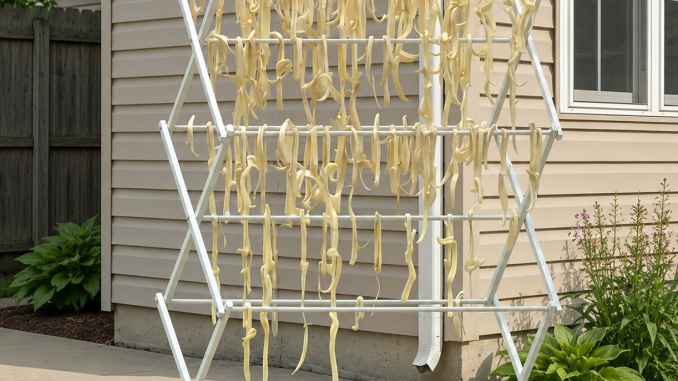
The first time I noticed it, I honestly thought something was wrong. Hanging outside my neighbor’s house, lined up carefully in the sunlight, were long pale strips swaying gently in the breeze. They looked strange, almost eerie from a distance, and once I spotted them, I couldn’t stop thinking about them.
Every morning during my usual walk, my eyes drifted back toward the yard. The objects were always there — hanging neatly in rows, motionless except when the wind nudged them softly back and forth. Their pale yellow color and unusual shape made them look unfamiliar enough to spark my imagination. At first, I tried to ignore it, but curiosity slowly turned into a strange obsession.
My mind started inventing explanations. Maybe they were part of some unusual craft project. Maybe gardening equipment I had never seen before. On certain days, my imagination became even more dramatic, creating ridiculous theories that only made the mystery feel bigger.
Soon, checking on them became part of my routine. I adjusted my walks just to pass by the house again. Morning or evening, I found myself glancing toward the yard, hoping I’d finally understand what I was seeing. Yet nothing ever changed. The strange strips continued hanging quietly in perfect rows, almost like they were daring me to figure them out.
Each time I passed by, I felt a mix of curiosity and embarrassment. I knew it was silly to be so invested in something so ordinary-looking, yet the mystery kept pulling me back in. I even started wondering if everyone else already knew what they were and I was the only person completely confused.
Eventually, my curiosity won.
One afternoon, I stopped to talk to a neighbor who was watering flowers nearby. Trying not to sound ridiculous, I asked, “Have you noticed those strange things hanging outside the Thompson house?”
The woman laughed almost immediately.
“They’re homemade noodles,” she said, smiling. “They’re drying them outside.”
That single sentence erased weeks of unnecessary mystery.
All the strange theories I had imagined disappeared instantly. The objects that had seemed suspicious or unsettling were nothing more than fresh pasta hanging in the sun. Simple. Harmless. Homemade noodles prepared for a future meal.
I couldn’t help laughing at myself afterward. My imagination had transformed something completely ordinary into an elaborate mystery. What I had viewed with suspicion was actually a quiet and comforting part of everyday life — someone carefully making food by hand and letting it dry in the afternoon sun.
After that, the scene looked completely different to me.
Now, when I walk past the house, I notice the noodles with appreciation instead of confusion. I picture someone inside kneading dough, carefully shaping each strand, continuing a simple tradition with patience and care. What once seemed strange suddenly felt warm and human.
The experience taught me something unexpected: how easily we create stories when we don’t fully understand what we’re seeing. Without context, even the most ordinary things can seem mysterious or unsettling. Our minds naturally try to fill in the blanks, and sometimes we invent fear where none exists.
Those hanging noodles became a small reminder that perspective changes everything.
What once looked eerie now feels almost beautiful — the pale strands catching sunlight, moving gently in the breeze, quietly representing the rhythm of daily life. Since then, I’ve started noticing other simple moments around the neighborhood too: someone trimming flowers carefully, a neighbor sweeping their porch, children laughing in nearby yards. Small details I probably would have overlooked before.
The entire experience made me realize how important patience and understanding can be. Sometimes things only seem strange because we don’t yet know the story behind them. Often, the explanation is much simpler — and far more comforting — than we imagine.
Now whenever I see those noodles drying outside, I smile. The mystery may be gone, but the lesson remains. Sometimes the ordinary can look mysterious from a distance, and sometimes all it takes is a little context to turn confusion into appreciation.
In the end, the hanging noodles became more than just noodles to me. They became a reminder that life’s simplest moments often carry unexpected beauty — and that curiosity, when paired with understanding, can transform fear into something meaningful and even heartwarming.