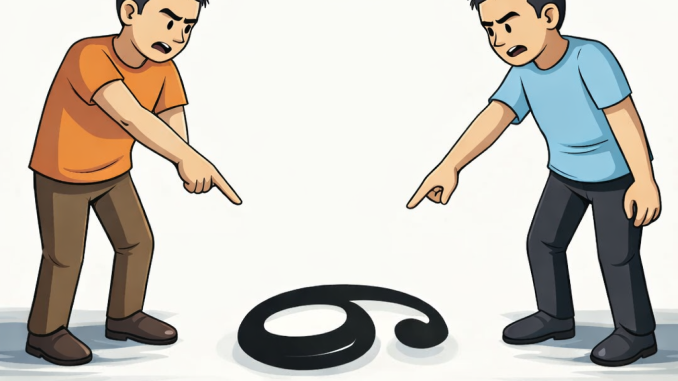
At first glance, the image seems simple. Two people are standing across from each other, looking at the same number written on the ground. One confidently says it’s a “6,” while the other insists it’s a “9.” Both are certain. Both are pointing. Both believe they are right.
So… who is correct?
The answer isn’t as straightforward as it looks.
From one side, the number clearly appears as a “6.” From the opposite side, it undeniably looks like a “9.” The truth is, neither of them is wrong — they’re simply seeing the same reality from different perspectives.
This powerful visual is more than just a clever illustration. It reflects something much deeper about human behavior, communication, and everyday life.
Perspective Shapes Reality
In real life, we often find ourselves in situations similar to this image. Two people can experience the same event, hear the same words, or see the same situation — yet come to completely different conclusions.
Why?
Because perspective shapes how we interpret the world.
Our background, experiences, beliefs, and emotions all influence how we see things. What seems obvious to one person may look completely different to someone else. And just like the “6” and “9,” both viewpoints can feel 100% correct from where each person is standing.
The Problem With Always Wanting to Be Right
One of the biggest challenges in communication is the need to prove that we are right and others are wrong. This mindset often leads to arguments, misunderstandings, and unnecessary conflict.
But what if the goal wasn’t to “win” the argument?
What if the goal was to understand?
The image reminds us that sometimes, instead of arguing, we should take a step back and consider the other person’s point of view. Not because we must agree — but because understanding creates connection.
Seeing Through Someone Else’s Eyes
Empathy is the ability to see the world through someone else’s perspective. It doesn’t mean abandoning your own view, but it means being open enough to recognize that another perspective can exist alongside yours.
In the case of the “6” and “9,” the solution is simple: walk around and look from the other side. In real life, it’s not always that easy — but the principle remains the same.
Listen. Ask questions. Try to understand.
You might discover that what you thought was completely wrong… actually makes sense from a different angle.
A Simple Lesson With a Powerful Meaning
This image carries a timeless message:
Not every disagreement has a single correct answer.
Sometimes, the truth is shaped by perspective. Sometimes, both sides hold a piece of the truth. And sometimes, understanding matters more than being right.
So… Who Is Correct?
Maybe the better question isn’t who is correct — but rather:
Are you willing to see it from the other side?