For six days, I watched a dog slowly lose hope on the balcony across from my apartment.
I first noticed him on Monday morning while working from home. My desk faces the building next door, and at first, the barking was impossible to ignore. It was sharp, desperate, and frightened — not the kind of barking a dog makes for attention, but the kind that sounds like a plea.
I looked out my window and saw him standing on a small third-floor balcony. He was golden-colored, thin, and restless, pacing from one side to the other. Every few minutes, he would stop near the sliding glass door and stare inside, as if waiting for someone to open it.
But no one came.
By Tuesday, the barking had almost stopped. That scared me even more. He no longer had the strength to keep calling out. He just stood there silently, watching the door, waiting for the person who had left him behind.
I called animal control and explained everything. They took my information and told me someone would check on it. I waited all day, watching from my window, hoping to see help arrive.
No one did.
On Wednesday, I called the non-emergency police line. They listened politely, then told me it was not a police matter and advised me to contact animal control again.
So I did.
Again, nothing changed.
By Thursday, I could see the shape of his ribs beneath his fur. He moved slower now. When the sun hit the balcony, he tried to hide in the little shade he could find, but there was almost none. There was no bowl of food. No fresh water. No blanket. Nothing.
I tried calling the apartment manager. I left messages. I sent emails. I even walked over to the building and looked for someone who might know who lived there. Most people shrugged. A few said they had heard the barking. One person said the tenant had not been seen in days.
Still, nobody did anything.
Friday morning was the worst.
The dog collapsed on the concrete and did not get up for hours.
That was when I called the fire department, almost crying as I explained that an animal was trapped and starving on a balcony. The person on the phone sounded sorry, but the answer was the same: unless there was immediate danger to a human being, they could not send a crew.
I hung up and sat by the window feeling completely helpless.
The dog barely moved that night.
On Saturday morning, I was still sitting there, exhausted and heartbroken, when I heard a motorcycle pull up outside.
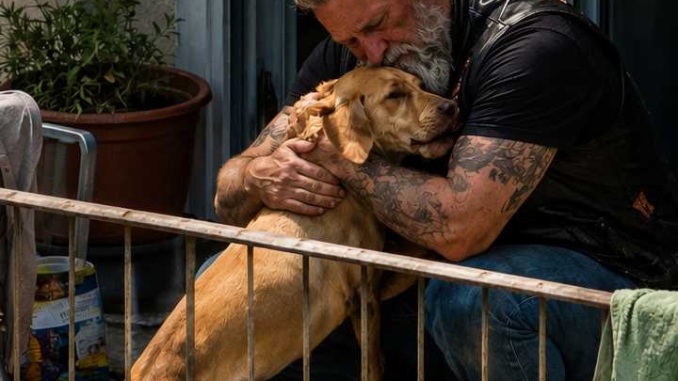
A man got off the bike. He was broad-shouldered, gray-bearded, with tattooed arms and a worn leather vest. At first, I thought he was visiting someone in the building. But then he stopped on the sidewalk and looked up.
He saw the dog.
He stood there for a long moment, not moving, just staring at that balcony.
I ran downstairs before I could even think.
“Are you seeing this?” I asked him.
He looked at me, then back up.
“How long?” he asked.
“Six days,” I said. “I’ve called everyone. Animal control, police, the manager, even the fire department. Nobody will help.”
His jaw tightened.
“The dog hasn’t eaten?” he asked.
“I don’t think so. I haven’t seen food or water once.”
He was quiet for a few seconds. Then he looked at the building carefully, studying the balconies.
“I’ll get him,” he said.
I thought I had misheard him.
“What?”
“I said I’ll get him.”
“You can’t climb that,” I told him. “It’s three stories. You could fall.”
He looked up at the dog again.
“That dog is running out of time.”
Before I could stop him, he walked to the building and grabbed the railing of the first-floor balcony. The balconies were staggered, just close enough that a strong person might be able to move from one to the next.
Might.
He pulled himself up.
People began coming out of nearby apartments. Some watched in silence. Others took out their phones and started recording. Someone shouted that he was crazy. Someone else yelled for him to get down.
But he kept climbing.
From the first balcony, he reached toward the second. His boot slipped once, and the entire crowd gasped. My heart nearly stopped. But he caught himself, held tight, and pulled his body upward.
The dog had finally lifted his head.
It was as if he understood someone was coming.
When the biker reached the third-floor balcony, he moved slowly and carefully, so he would not scare the dog. The poor animal tried to stand, but his legs trembled. The biker crouched down and spoke softly to him.
Even from below, I could see the dog lean toward him.
Then the biker wrapped one arm around the dog and held him close.
The crowd went silent.
For a moment, nothing mattered except that starving dog resting his head against the chest of a stranger who had decided his life was worth the risk.
The biker found the balcony door locked. He looked around, then carefully lifted the dog into his arms. Climbing down with him was even more dangerous than climbing up alone.
Someone below called out, “Don’t do it!”
But he did.
Slowly, step by step, balcony by balcony, he made his way down while holding the dog against him. People stood frozen, barely breathing.
When his boots finally touched the ground, the crowd erupted.
Some people clapped. Some cried. I just ran forward with tears in my eyes.
The dog was weak, shaking, and horribly thin, but he was alive.
The biker carried him to the shade and asked for water. Someone brought a bowl. Another person brought a towel. The dog drank slowly at first, then rested his head against the biker’s arm like he already knew he was safe.
Animal control arrived after that.
Only after that.
They checked the dog, spoke to witnesses, and began asking questions about the apartment. I do not know what happened to the person who left him there. I only know what happened to the dog.
The biker stayed with him until help took over.
Before he left, I asked his name.
He just shook his head.
“Doesn’t matter,” he said. “Just make sure he gets a real home.”
Then he got back on his motorcycle and rode away like he had not just done what an entire system refused to do.
I still think about that moment often.
Not because it was dramatic. Not because people recorded it. But because for six days, so many people had reasons why they could not help.
And then one stranger arrived, looked up, and decided that a helpless life was reason enough.