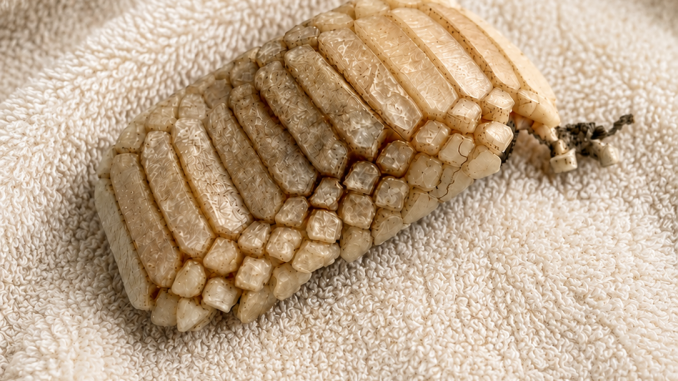
What started as a single viral photo quickly exploded into a worldwide mystery. The image showed a bizarre, fleshy object washed ashore on a crowded beach, and people everywhere were convinced it was something terrifying. Its rough texture, unusual shape, and strange patterns looked almost unreal — as if it belonged in a science fiction movie rather than in the ocean.
Some viewers claimed it resembled rows of sharp teeth, while others thought it looked like a mutated creature mixed with mechanical parts. Social media instantly filled with theories. Some believed it was a deep-sea predator never seen before. Others were convinced it was evidence of alien life or even a secret government experiment gone wrong.
As the photo spread across the internet, fear and curiosity only intensified. Zoomed-in images revealed intricate ridges and structures that appeared disturbingly unnatural. News pages, forums, and viral accounts all shared their own theories, turning the mysterious object into a global sensation.
But after experts carefully analyzed the image, the truth turned out to be far less frightening — and far more fascinating.
The so-called “monster” was actually the underside of a harmless chiton, a small marine mollusk commonly found along rocky coastlines. Normally, chitons are overlooked because their top side looks simple and shell-like. However, this one had been flipped upside down, exposing anatomical features most people never see.
Its unusual underside revealed a muscular foot surrounded by gripping structures used to cling tightly to rocks. Once dried in the sun, these structures created patterns that resembled sharp teeth or mechanical armor, giving the creature its terrifying appearance.
Scientists explained that the ridges mistaken for monstrous teeth are part of the chiton’s radula — a specialized feeding organ used to scrape algae from rocks. Even more incredible, these tiny teeth contain magnetite, a naturally occurring iron mineral that makes them one of the strongest biological materials found in nature.
In reality, the “alien creature” wasn’t dangerous at all. It was simply a misunderstood marine animal viewed from an unfamiliar angle. The viral panic became another example of how quickly fear and misinformation can spread online when people encounter something they do not understand.
Rather than a terrifying monster, the chiton turned out to be a remarkable example of nature’s hidden complexity — proof that sometimes the strangest things on Earth are completely real, just rarely seen.