At first, this famous little riddle seems so easy that most people are convinced they know the answer immediately. But the more they think about it, the more confusing it becomes. That is exactly why thousands of people online keep arguing over it, with answers ranging from 200 dollars to 170 dollars, while others swear the loss is only 130 dollars. The trick is that the wording quietly pushes people into counting the same money more than once.
Here is the situation:
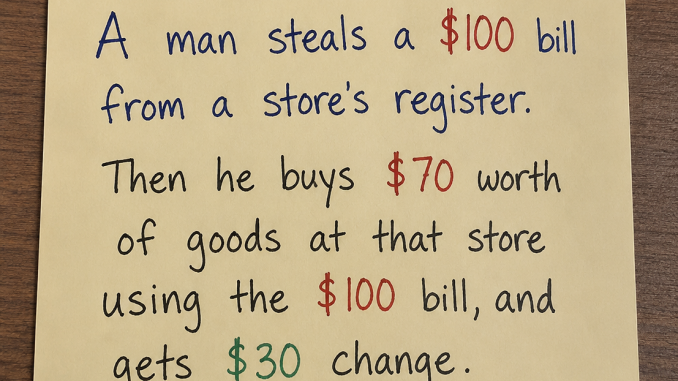
A man steals a 100 dollar bill from a store’s register. Later, he returns to that same store and buys 70 dollars worth of merchandise using the stolen bill. The cashier unknowingly accepts the money and gives him 30 dollars in change.
So how much did the store actually lose?
The reason this puzzle confuses so many people is because the stolen 100 dollar bill eventually makes its way right back into the register. Since the bill returned to the store, it is no longer missing and should not be counted as part of the final loss.
A much simpler way to look at it is this:
Imagine the thief simply walked into the store and demanded 70 dollars worth of products plus 30 dollars in cash without paying anything at all. That would clearly leave the business short by exactly 100 dollars.
When you track the actual movement of value, the answer becomes obvious:
• The thief first steals 100 dollars from the register.
• He later returns that same 100 dollar bill to the store when paying for the items.
• The store then gives him 70 dollars in merchandise and 30 dollars in cash change.
In the end, the store is missing 70 dollars worth of goods and 30 dollars in cash.
Total loss: 100 dollars.
That is what makes this riddle so addictive. It does not test complicated math skills — it tests whether your brain can follow the movement of value without accidentally counting the same money twice.