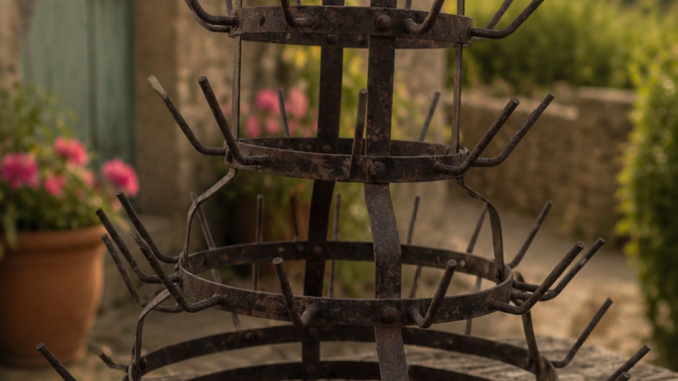
Inside the quiet kitchen of a 1907 home, history lingers in every corner. Sunlight slips through tall windows, casting soft shadows across aged wooden floors and long-forgotten fixtures. Though the stove no longer burns and the sink sits silent, the room still carries echoes of a time when daily life revolved around discipline, routine, and practical ingenuity. Among the many relics left behind, one unusual object often captures attention — a strange metal structure resembling a small tree, lined with rows of upward-pointing arms.
At first glance, it appears decorative or industrial, perhaps even artistic. Yet this forgotten object once played an essential role in household survival. It was a bottle drying rack, a simple but remarkably effective tool used in early 20th-century kitchens to keep reusable glass bottles clean, dry, and ready for daily use.
Long before disposable containers became common, families depended heavily on reusable glass bottles and jars. Milk bottles, homemade preserves, syrups, and beverages all required careful washing and sanitation. Hygiene was critical, and the drying rack offered the perfect solution. Bottles could be placed upside down on each metal prong, allowing water to drain naturally while air circulated freely inside the glass.
Its design was simple, durable, and efficient — qualities that defined many household tools of the era. But the rack represented more than practicality. It was part of a larger rhythm of domestic life, where every family member contributed to the smooth operation of the home. Children learned how to wash and arrange bottles properly, while older generations passed down routines and methods through experience rather than instruction manuals.
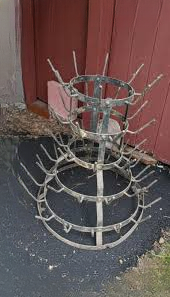
In many ways, the rack reflected the values of its time: resourcefulness, discipline, and zero waste born from necessity rather than trend. Nothing was disposable. Glass bottles were valuable, household items were expected to last for decades, and tools had to withstand constant use. Every object served a clear purpose.
As modern conveniences transformed kitchens throughout the 20th century, tools like this slowly disappeared. Disposable packaging replaced reusable containers, and many once-essential household items were abandoned, stored away, or forgotten entirely. Today, people who discover these racks often mistake them for decorative stands, industrial fixtures, or abstract sculptures until their true purpose is revealed.
Now, many surviving bottle drying racks have found new life as rustic décor, mug holders, or vintage conversation pieces. Yet beyond their nostalgic appearance lies a deeper story about how earlier generations lived — a world where routines mattered, waste was minimized, and household survival depended on cooperation and care.
Standing quietly in an old kitchen, the forgotten “metal tree” becomes more than a curious antique. It serves as a reminder of a slower, more intentional way of life, where even the simplest tools carried meaning and every object earned its place within the home.