My name is Michelle, and my son Ethan is nine years old. He was diagnosed with severe autism when he was two. He is non-verbal, sensitive to sounds and textures, and sometimes experiences meltdowns that can last for hours. But beyond all of that, he is the most beautiful, intelligent, loving child I have ever known.
His father never truly understood that.
Eight months ago, David left us. He packed a bag while Ethan was at therapy and left a note on the kitchen counter. In it, he said he could not do it anymore. He said he had not signed up for a “broken kid.”
Broken.
That one word stayed with me.
Ethan may not speak, but he understands far more than people realize. When he came home, he walked from room to room, opening empty drawers and closets, searching for the father who had disappeared without saying goodbye.
After that day, my son stopped smiling.
He stopped making his happy sounds. He stopped reaching for me. His therapists called it regression caused by trauma, but to me, it felt like I was watching my child slowly disappear behind a wall I could not break through.
For months, I tried everything. New routines, new therapy plans, sensory tools, extra patience, and every bit of love I had left. Nothing seemed to bring him back.
Then one Tuesday afternoon, everything changed.
I had just left another difficult therapy session where the therapist gently suggested that Ethan might need more care than I could give him at home. I was crying at a red light, barely able to see through my tears, when the sound of motorcycles filled the street.
Fifteen bikers surrounded our minivan.
At first, I panicked. Loud, unexpected sounds usually upset Ethan. I reached for his noise-canceling headphones, expecting him to scream.
But he didn’t.
Instead, he leaned forward, staring out the window with wide eyes. For the first time in eight months, I saw something on his face that looked like interest.
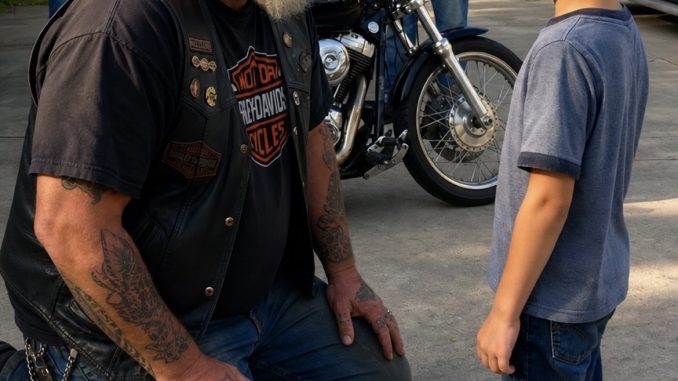
One older biker pulled up beside Ethan’s window. He had a gray beard, a leather vest, and military patches. When he noticed Ethan watching, he gently revved his engine in a pattern.
Three short revs. A pause. Two longer revs. Another pause. Three short revs.
Ethan’s eyes lit up.
The biker did it again.
And then my son laughed.
Not a tiny laugh. Not a forced sound. A real, joyful laugh that came from deep inside him — the kind I thought I might never hear again.
The biker smiled and pointed toward a nearby gas station parking lot. Every cautious thought in my head told me not to follow strangers, but my son was laughing. He was present. He was alive in a way I had not seen in months.
So I pulled in.
The biker introduced himself as Thomas. He told me his grandson was autistic too and loved engine sounds because, as he put it, “the bikes talk in patterns.”