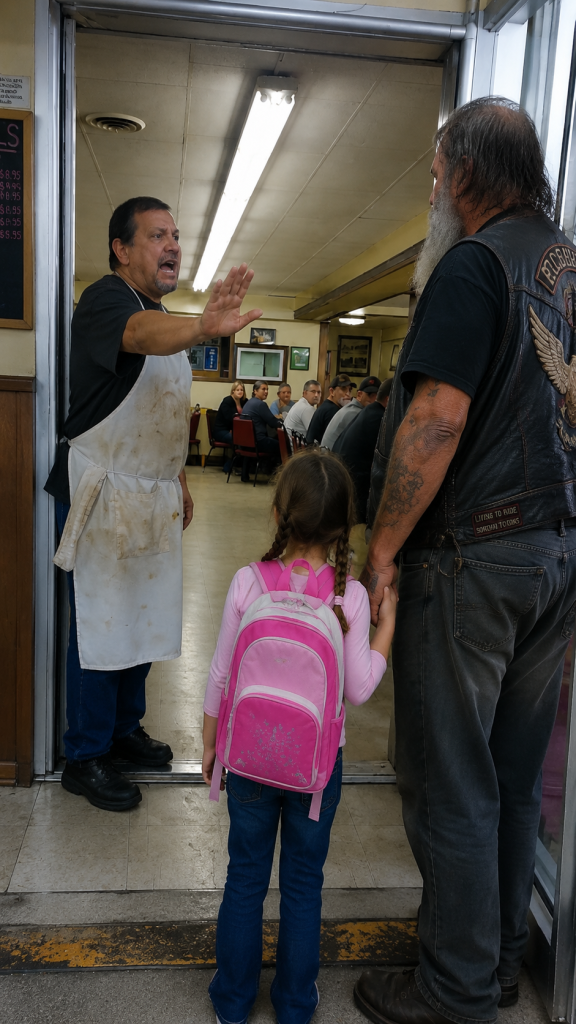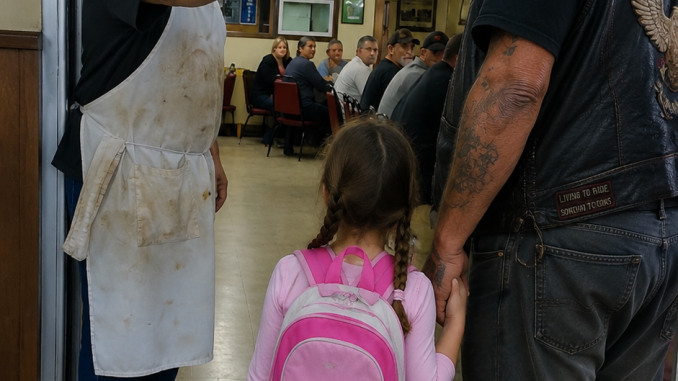
The biker walked into my restaurant on a quiet Tuesday afternoon, and the entire room seemed to freeze for a second.
He was huge. Leather vest covered in patches. Tattoos climbing up both arms. Thick beard down to his chest. Dust on his boots like he’d been riding for days without stopping.
And holding his hand was a tiny little girl.
She couldn’t have been older than five. Pink backpack. Tiny sneakers. Two messy braids already falling apart.
Before they could sit down, I stepped in front of them.
“Sir, I’m going to have to ask you to find somewhere else to eat,” I said quietly, trying not to make a scene.
The man looked at me for a long moment. He didn’t argue. Didn’t raise his voice.
“We just need something to eat,” he said softly. “She hasn’t eaten since yesterday.”
For a second, I almost changed my mind.
Almost.
But then I noticed customers staring. A mother holding her toddler closer. A couple near the window watching me like they expected me to “handle it.”
So I hardened myself.
“I’m sorry,” I said. “I can’t seat you.”
The biker lowered his eyes and gave a small nod. The kind of nod people give when disappointment doesn’t surprise them anymore. He turned toward the door.
Then the little girl tugged gently on his hand.
She looked straight at me and whispered one word.
“Please.”
Not like a child begging for candy.
Like someone already used to hearing “no.”
That single word hit me harder than anything else could have.
I looked at them again. Really looked this time.
The biker’s hands were trembling around hers. His knuckles were raw and split open. His eyes were red like he hadn’t slept in days. And suddenly he didn’t look dangerous at all.
He looked exhausted.
Broken, even.
I finally noticed the little things I’d ignored at first. The girl’s backpack hanging by one strap. The stuffed rabbit missing one ear. The tiny ziplock bag inside with two crushed saltine crackers at the bottom.
That was all they had left to eat.
My stomach twisted.
Without another word, I grabbed two menus and led them to the corner booth.
The little girl climbed onto the seat carefully, hugging her rabbit like it was treasure. I walked straight into the kitchen and told Marcus, my cook, to make two full specials with extra portions.
“And don’t charge them a dime,” I added.
Marcus looked through the kitchen window at the booth, then back at me. He didn’t ask questions. He just turned on the grill.
A few minutes later, I brought out a coffee for the biker and a large glass of milk for the little girl.
She wrapped both hands around the glass and drank almost half of it without stopping. Then she smiled for the very first time and whispered, “Thank you.”
I had to walk away before I lost it.
When the food arrived, the girl stared at the plate like she couldn’t believe it was real. Meatloaf, mashed potatoes, green beans, cornbread — hot food, real food.
She looked up at the biker for permission.
He nodded once.
And she started eating carefully at first… then faster and faster, like she was afraid the plate might disappear.
“Slow down, baby,” he told her gently. “It’s not going anywhere.”
But the way she kept glancing at the food told me maybe, in her world, meals did disappear.
The biker barely touched his own plate at first. He mostly watched her eat. Every few seconds he checked on her like he needed to reassure himself she was still there.
The entire restaurant had gone quiet by then.
Even the couple who originally wanted them gone kept watching from their table.
Eventually, the woman stood up, walked to the register, and quietly placed sixty dollars on the counter.
“For them,” she whispered.
Then old Gerald — an 82-year-old retired teacher who ate lunch at my diner three times a week — slowly walked over to their booth.
I was worried for a second, but Gerald simply sat down across from the biker and pointed at one of the patches on his vest.
“Army?” he asked.
The biker nodded. “Afghanistan. Two tours.”
Gerald smiled faintly. “Korea.”
Something passed between those two men in that moment. Something silent and heavy.
Gerald spent the next ten minutes talking to Lily about her stuffed rabbit, whose name turned out to be Captain. By the end of it, Lily was laughing so hard milk nearly came out of her nose.
It was the first real childlike laugh I’d heard from her all afternoon.
Before leaving, Gerald shook the biker’s hand firmly and said something too quiet for me to hear.
But I saw the biker’s eyes fill with tears anyway.
Later, when the lunch rush died down, I finally sat at their booth for a moment.
“I owe you an apology,” I told him quietly.
He stared into his coffee for a long time before answering.
“People see the leather and assume the worst,” he said calmly. “I’m used to it.”
“That doesn’t make it right.”
He glanced at Lily, who was now carefully wrapping leftover cornbread in napkins to save for later.
Then he finally told me the truth.
“Her mama passed away four months ago.”
He said it flatly. No drama. No pity.
Just exhaustion.
Turns out he’d been sleeping wherever he could while trying to get to his sister’s place two states away. His motorcycle had broken down outside town the night before. He spent his last few dollars on gas and a cheap motel until the money ran out completely.
He wasn’t a criminal.
He wasn’t dangerous.
He was just a father trying desperately not to fail his little girl.
And I almost sent them back out into the cold because of the way he looked.
Before they left, Lily walked back up to the counter holding Captain the rabbit in one arm.
“Captain says thank you too,” she told me seriously.
Then she reached into her tiny backpack and pulled out something folded.
A crayon drawing.
It showed a little diner with a giant smiling stick figure wearing a beard beside a little girl holding a rabbit.
Above it, in shaky letters, she’d written:
“Thank you for letting us stay.”
I still keep that drawing taped inside my office today.
Because every time I look at it, I remember how easy it is to judge someone in the first five seconds… and how sometimes the people we fear the most are the ones carrying the heaviest pain.